Author: Launchieve App Publishing Team•Technical Review: Senior Store Compliance & Policy Engineers•Published: November 4, 2026•Last Updated: November 4, 2026
Editorial Disclosure: Sourced directly from official Apple App Review and Google Play Console Help documentation checked on November 2, 2026. Launchieve offers fixed-price rejection plans, code remediation, and store publishing services, described transparently below. No service can speed up review or guarantee approval; Apple and Google make all final decisions.
What is the short answer on App Store vs Google Play?
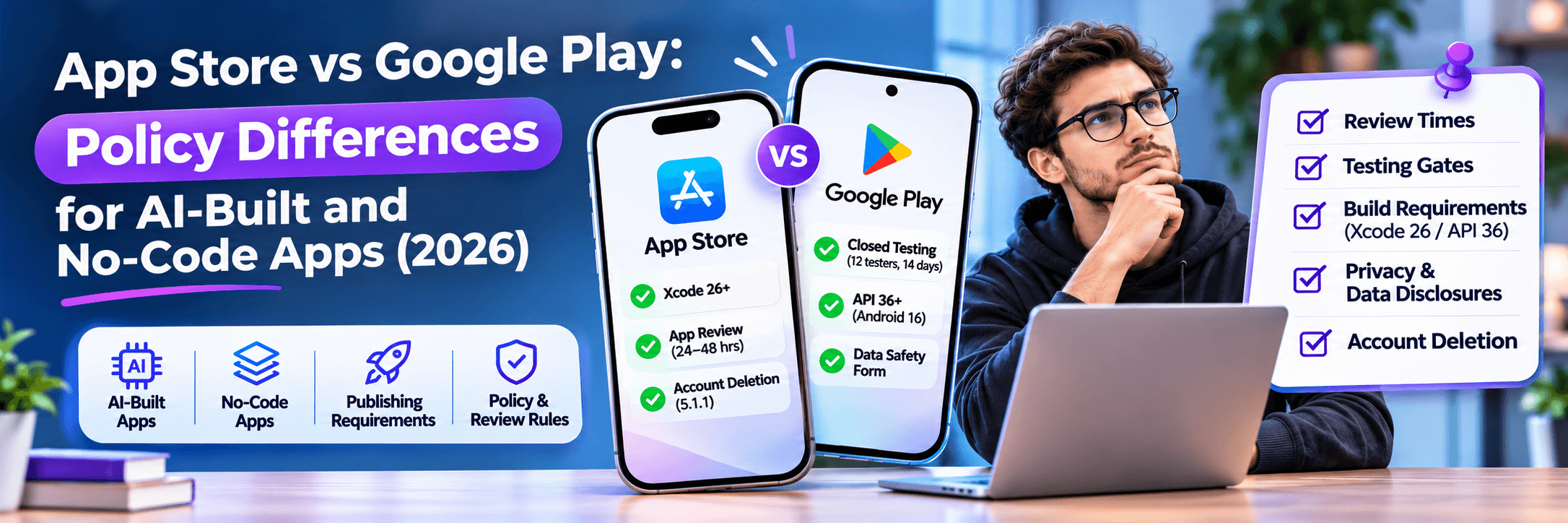
Apple's App Store and Google Play both require working demo logins, accurate privacy disclosures, and in-app account deletion. They differ in review gates. Google requires new personal accounts to run a closed test with 12 testers for 14 continuous days. Apple has no equivalent gate but requires builds compiled with Xcode 26. Launchieve, a fix, audit, and publishing service for AI-built apps with published prices, helps bridge these technical gaps. No service can guarantee approval; Apple and Google decide.
📌 Key Takeaways
- Both stores share core requirements: Working demo logins, accurate privacy declarations covering SDKs, and native account deletion workflows.
- Google has a mandatory testing gate, Apple does not: Personal Google developer accounts created after November 13, 2023 must run a closed test with at least 12 opted-in testers for 14 days before applying for production. TestFlight on Apple is completely optional.
- Build requirements updated in 2026: Apple requires Xcode 26 and the iOS 26 SDK since April 28, 2026. Google Play requires targeting API 36 (Android 16) for all new apps and updates since August 31, 2026.
- Privacy disclosures are developer-completed: Both Apple App Privacy labels and Google Play Data safety forms require explicit accounting for every embedded SDK and backend telemetry hook.
- No service controls the queue: No agency, developer, or software tool can guarantee store approval or expedite review timelines.
Why Do AI-Built and No-Code Apps Hit the Rejection Wall?
Apple states that over 40% of unresolved submission issues relate to Guideline 2.1 App Completeness (Apple App Review Documentation), covering crashes, placeholder content, and broken flows across all developer submissions.
For founders using AI tools such as Lovable, Bolt, Replit, or Base44, code generation models excel at assembling front-end interfaces, but do not automatically produce reviewer notes, demo bypass credentials, privacy manifests, account deletion hooks, or compliant store metadata.
Web Wrapper & Template Traps (Guidelines 4.2 & 4.2.6)
Apple Guideline 4.2 mandates that mobile apps deliver value beyond a repackaged website or simple container. Additionally, Guideline 4.2.6 specifies that apps built from commercialized templates or automated app-generation services are rejected unless submitted directly by the content owner with unique native capabilities.
What Does Apple's App Store Review Check?
1. Review Speed & Timelines
Apple states that App Review typically evaluates at least 50% of submissions in less than 24 hours, and 90% in less than 48 hours. However, incomplete submissions, novel IAP flows, or missing demo access will delay review significantly.
2. Demo Accounts & Live Backend (Guideline 2.1a)
If your app requires authentication, you must provide active demo credentials with pre-loaded sample data in the App Review Information section of App Store Connect. If your backend is in sandbox mode or requires live SMS codes, reviewers will fail to log in and reject the build.
3. Digital Payments & In-App Purchase (Guideline 3.1.1)
Unlocking digital features, premium access, or AI credits must strictly use Apple In-App Purchase (IAP). In the US storefront, apps may include external purchase links without an entitlement, whereas other geographic regions require StoreKit External Purchase Link Entitlements.
4. In-App Account Deletion (Guideline 5.1.1v)
Apple's rule is explicit: “If your app supports account creation, you must also offer account deletion within the app.” Deactivation or asking users to send an email does not meet this requirement.
5. App Privacy Details & Privacy Manifests
You must complete the App Privacy nutrition label in App Store Connect, detailing all data collected by your code and third-party partners. Apple strictly requires Privacy Manifests (PrivacyInfo.xcprivacy) for commonly embedded SDKs.
6. Social Login & Equivalent Options (Guideline 4.8)
If your app offers social or third-party login (such as Google or Facebook), you must also provide an equivalent privacy-focused login service such as Sign in with Apple that permits users to hide their personal email address.
7. Current Build Requirements (Xcode 26 & iOS 26 SDK)
Since April 28, 2026, all binary uploads to App Store Connect must be built using Xcode 26 or later and target the iOS 26 SDK. Age rating questionnaires in App Store Connect are mandatory. TestFlight is optional, but external testers require initial App Review approval.
What Does Google Play Require?
The 14-Day 12-Tester Closed Testing Gate
Personal Google Play developer accounts created after November 13, 2023 must run a closed test with at least 12 testers opted in continuously for at least 14 days. Only after completing this window can developers click “Apply for production” and answer Google's qualitative evaluation questions. Production access review typically takes 7 business days or less.
1. Target API Level (API Level 36 / Android 16)
Since August 31, 2026, all new Android apps and updates must target API 36 (Android 16) or higher. Wear OS and Automotive apps require API 35, while TV and XR apps require API 34.
2. Data Safety Form & SDK Transparency
Every production app must complete Google Play's comprehensive Data Safety section. You must disclose data collected, shared, and encrypted across your own application and every embedded library from the Google Play SDK Index.
3. Dual Account Deletion (In-App + Public Web Link)
If your app allows user account registration, Google requires an in-app account deletion flow plus an accessible public web URL where users can request complete deletion of their account and associated data without reinstalling the app.
4. Google Play Billing & Content Rating
Google Play Billing is mandatory for digital features and in-app consumables, with established exemptions for physical goods and services. Developers must also complete the IARC Content Rating questionnaire and provide demo login credentials.
Table 1: Apple App Store vs Google Play Policy Comparison
Detailed comparison based on official store rules checked on November 2, 2026:
| Policy Area | Apple App Store | Google Play | Who Can Help |
|---|
| Review Speed | 50% under 24 hrs, 90% under 48 hrs | Automated pre-checks; reviews take 2 to 7+ days | No service can speed up review |
| Pre-Launch Gate | None required (TestFlight is optional) | 12 testers, 14 continuous days (personal accounts) | Developer coordinates testing |
| Payments | StoreKit IAP for digital goods (3.1.1); US external link rules | Google Play Billing for digital goods and services | Your engineer / Launchieve Fix Pack |
| Privacy Disclosures | App Privacy nutrition label + SDK Privacy Manifests | Data safety form covering internal code and SDKs | Launchieve App Store Launch ($799) |
| Account Deletion | Direct in-app deletion required (5.1.1v) | In-app path + accessible public web URL | Launchieve App Fix Pack ($399) |
| Third-Party Login | Equivalent privacy login required (Guideline 4.8) | No equivalent rule; working credentials required | Your developer |
| Build Requirement | Xcode 26 + iOS 26 SDK (since April 28, 2026) | Target API 36 / Android 16 (since August 31, 2026) | Your developer |
| Wrapped Web Apps | Guidelines 4.2 & 4.2.6 (Minimum functionality) | Minimum functionality and broken webview policy | Launchieve Technical Audit ($299) |
Table 2: Common Rejection Patterns and Typical Fixes
Illustrative guideline friction points encountered by no-code and AI-built applications:
| Rejection Pattern | Cited Rule Area | Typical Technical Fix |
|---|
| Reviewer cannot sign in | Apple 2.1; Google demo instructions | Provide working demo credentials, bypass 2FA, and verify active production backend. |
| Placeholder text or crashes | Apple 2.1 App Completeness | Purge Lorem ipsum copy, remove dummy assets, and test every screen on physical hardware. |
| Missing account deletion | Apple 5.1.1(v); Google account deletion | Add direct in-app account deletion, plus an external web deletion request page for Google. |
| Social login missing equivalent option | Apple Guideline 4.8 | Implement Sign in with Apple or equivalent privacy-focused authentication. |
| Digital goods bypassing store billing | Apple 3.1.1; Google Play Billing | Route digital credits and upgrades through native StoreKit and Play Billing SDKs. |
| Privacy disclosures mismatch SDK behavior | Apple App Privacy; Google Data safety | Audit all embedded SDKs (Firebase, analytics, ads) and align store questionnaire answers. |
| Web wrapper lacking native functionality | Apple Guideline 4.2 & 4.2.6 | Add offline access, native push notifications, haptics, camera APIs, or biometric authentication. |
| Closed test tester drop-off | Google closed testing requirement | Recruit 15-20 testers to maintain a buffer, ensure continuous opt-in, and log active engagement. |
Pre-Submission Verification Checklists
🍎 Apple App Store Checklist
- Add working demo credentials and setup notes in App Store Connect.
- Route digital purchases strictly through StoreKit In-App Purchase.
- Complete App Privacy details and verify third-party SDK Privacy Manifests.
- Offer direct in-app account deletion if users can register an account.
- Provide Sign in with Apple or equivalent if offering third-party social logins.
- Compile binaries with Xcode 26 targeting iOS 26 SDK or higher.
- Complete the age rating questionnaire in App Store Connect.
- Audit against web wrapper rejections (Guideline 4.2).
- Maintain active, functional hosted privacy policy links.
🤖 Google Play Checklist
- Complete 14 days of closed testing with 12+ opted-in testers (personal accounts).
- Compile build targeting Android 16 (API Level 36) or higher.
- Complete the Data Safety questionnaire covering code and SDKs.
- Integrate Google Play Billing for digital goods and consumables.
- Provide both in-app account deletion and an external web request URL.
- Complete the official IARC content rating questionnaire.
- Provide credentials in App Access if authentication is required.
- Ensure store listing copy, screenshots, and promo graphics are accurate.
Table 3: Options for Fixing or Publishing an App
Compare available service tiers and developer alternatives:
| Option | Cost | Best Suited To | Main Limitations |
|---|
| Do It Yourself (DIY) | Free (Your time) | Founders comfortable debugging store guidelines, Xcode builds, and console questionnaires. | No professional policy review; potential rejection delays. |
| Freelance Marketplace | Hourly / Custom ($50-$150+/hr) | Isolated, well-defined technical bug fixes with clear requirements. | Varying store policy expertise; open-ended hourly risk. |
| Traditional Agency | $2,500 - $10,000+ | Complete native rebuilds, ongoing enterprise product engineering. | Lengthy sales cycles, high minimum commitments. |
| Launchieve Fixed-Price | $199 - $1,299 | AI-built and no-code apps (Lovable, Base44, Bolt, Replit) seeking upfront, capped pricing. | Defined scope; developer manages closed testing; no approval guarantee. |
How Does Launchieve Help, Step by Step?
Launchieve provides a structured suite of fixed-price verification, remediation, and publishing services tailored specifically for apps created with AI tools:
1. Free Launch Scan
An automated pre-launch scanner providing immediate signals on common surface flaws: start free scan.
2. Compliance Review ($299)
A comprehensive pre-submission audit resulting in an actionable “Ready or Needs Attention” roadmap.
3. Rejection Help ($199)
Deconstructs rejection notices from Apple or Google and supplies an exact, step-by-step technical fix plan.
4. App Fix Pack ($399)
5 dedicated senior engineer hours for login bugs, API disconnects, mobile layout adjustments, or launch blockers.
5. App Store Launch ($799)
Hands-on submission management for both stores, store listings, privacy declarations, and one resubmission cycle.
6. Launch Ready + Publish ($1,299)
Combines end-to-end technical pre-flight verification with complete store publishing management.
What you need: You must provide your own active Apple Developer and Google Play Console accounts, a hosted privacy policy, and a functional app build. Developer accounts stay 100% under your ownership.
Key Terms & Regulatory Concepts
Closed Test
A mandatory Google Play pre-launch gate requiring 12 opted-in testers for 14 continuous days for personal accounts.
Privacy Manifest
An Apple-mandated configuration file declaring third-party SDK data collection and required-reason API usage.
Data Safety Form
Google Play's required disclosure detailing user data collection, security encryption, and third-party sharing.
Target API Level
The Android SDK version targeted by an app build. New Google Play apps and updates require API 36 (Android 16).
How We Compiled This Guide (Primary Sources)
This policy guide is verified against official developer documentation as of November 2026. Review primary rules directly:
Frequently Asked Questions
How long does Apple's App Store review take?
Apple states that App Review typically reviews at least 50% of submissions in less than 24 hours and 90% in less than 48 hours. These are typical figures, not guarantees, and incomplete submissions can be delayed. No outside service can speed up review.
Does Google Play require 12 testers for 14 days?
Yes, for personal developer accounts created after November 13, 2023. The account must run a closed test with at least 12 testers opted in continuously for at least 14 days, then use Apply for production in Play Console. Low engagement can mean more testing.
What API level must my Android app target in 2026?
Since August 31, 2026, new apps and updates must target API 36 (Android 16) or higher. Wear OS and Automotive need API 35, and TV and XR need API 34. Existing apps need API 35 or higher to stay available to new users on newer Android versions.
Do I need Sign in with Apple if I use Google login?
Not necessarily, but you need an equivalent option. Under Guideline 4.8, apps using a third-party or social login for the primary account must also offer an equivalent login that limits data to name and email and lets users keep email private. Sign in with Apple is one way to comply.
Does my app need account deletion on both stores?
Yes, if your app lets users create accounts. Apple requires account deletion within the app under Guideline 5.1.1(v). Google requires an in-app path to delete the account and its data, plus a web link where users can request deletion. Plan both before you submit.
Can I use Stripe for in-app payments on iOS?
It depends on what you sell and where. Digital goods generally use in-app purchase under Guideline 3.1.1, but in the US storefront apps may include buttons, external links or calls to action without an entitlement. Other regions need StoreKit External Purchase Link Entitlements. Play Billing has exceptions, such as physical goods or services.
Why was my AI-built app rejected by Apple?
The rejection message names the guideline, so start there. Apple states that over 40% of unresolved issues relate to Guideline 2.1 App Completeness, such as crashes, placeholder content and incomplete information. Other common causes include login failures, missing account deletion, privacy label mismatches and web wrappers under Guideline 4.2.
Do I need TestFlight before submitting?
No, TestFlight is optional. You can submit to App Review without it. If you invite external testers, the first build must be approved by App Review before they can test it. TestFlight can still help you catch crashes and broken flows before a reviewer sees them.
Can I publish a Lovable or Bolt app to both stores?
Yes, if the app meets each store's rules, including Apple Guidelines 4.2 and 4.2.6. Launchieve supports Lovable, Base44, Bolt, Replit, Emergent and custom code. You need your own developer accounts, a working app and a privacy policy URL. Approval is never guaranteed.
Does Launchieve guarantee store approval?
No. Apple and Google make every approval decision, and Launchieve cannot guarantee it or speed up review. Its services aim to reduce avoidable gaps before submission. Rejection Help gives a plan, not automatic code changes, unlimited remediation cycles or guaranteed approval.
Ready to Publish Your AI or No-Code App with Complete Confidence?
Avoid weeks of rejection ping-pong between Apple and Google reviewers. Run our free 3-minute launch scanner for immediate architectural telemetry, or have our senior engineering team handle your full app publishing process from $799.
L
Launchieve Technical Review Team
Technical Audit Engineers
We review AI-built codebases across security, infrastructure, APIs, and launch readiness. Our team has audited products built with Cursor, Lovable, Bolt.new, Replit, Supabase, Firebase, and mixed AI-assisted workflows. Every finding in this article comes from patterns observed in real technical reviews — not theoretical scenarios.