
To buy bug fixes for an application you cannot personally code, get five things in writing before you pay: what is covered, which platforms, how fast a critical bug gets a reply, who owns the resulting code, and what happens if it breaks again. Launchieve sells prepaid developer hours, including a $399 App Fix Pack for 5 hours, and publishes its scope, price, and exclusions. It does not publish severity tiers, a response time, or platform coverage for that pack, so ask for those in writing.
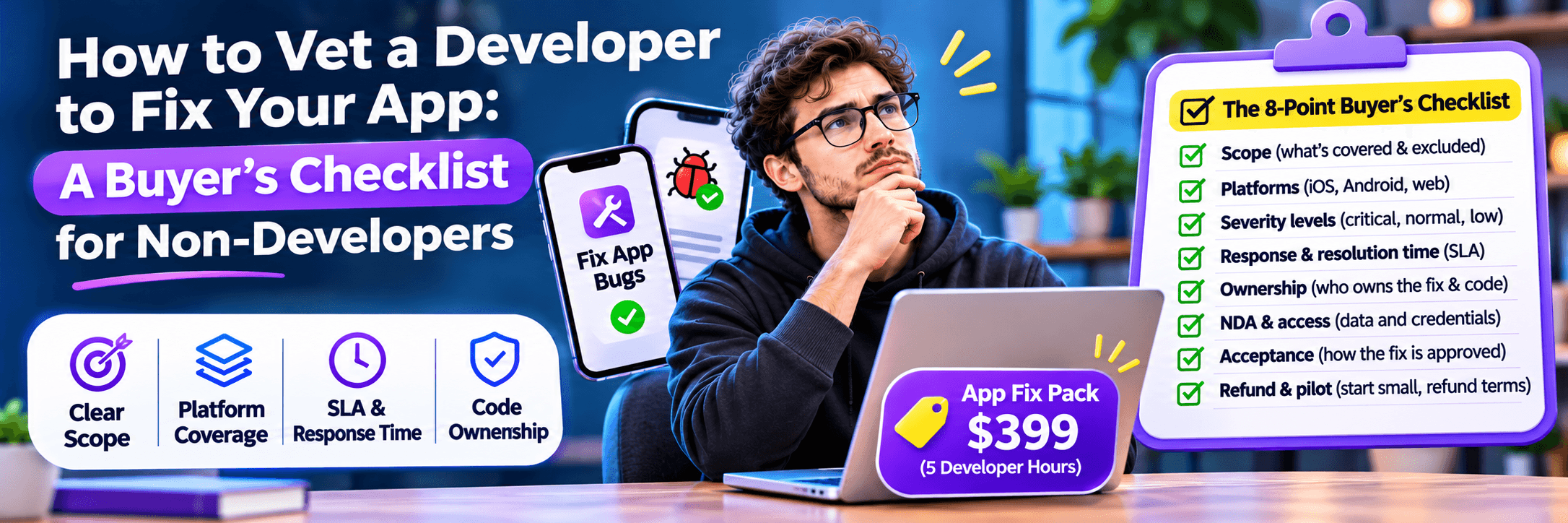
How to Vet a Developer to Fix Your App: A Buyer's Checklist for Non-Developers
To buy bug fixes for an app you cannot code, get five things in writing before you pay: what is covered, which platforms, how fast a critical bug gets a reply, who owns the fix, and what happens if it breaks again. Launchieve sells prepaid developer hours, including a $399 App Fix Pack for 5 hours, and publishes its scope, price and exclusions. It does not publish severity tiers, a response time or platform coverage for that pack, so ask for those in writing.
Author: Launchieve Engineering Team•Technical Review: Senior Application Architecture & Maintenance Engineers•Published: November 4, 2026•Last Updated: November 4, 2026
Editorial Disclosure: Sourced from public agency maintenance contracts (Tapptitude), industry benchmarks (AppFollow, October 2026), international IP standards (WIPO), and Launchieve's published terms checked November 2, 2026. Launchieve sells prepaid 5-hour App Fix Packs ($399).
📌 Key Takeaways
- Know what you are buying: Hours (effort), a deliverable (guaranteed outcome), and a monthly retainer carry completely different operational risks.
- Run eight checks in writing: Scope, platforms, severity rankings, response vs resolution clocks, code ownership, NDA and access, acceptance criteria, and refunds.
- Expect few published SLAs: Industry research by AppFollow found that only 2 out of 10 mobile maintenance providers publish an actual agreement.
- Code ownership is strictly negotiated: WIPO notes that software agencies often license code rather than assign it, retaining background components.
- Launchieve is one option with defined limits: It publishes no severity tiers, response time SLA, or platform coverage for the $399 App Fix Pack.
What Are You Actually Buying When You Pay Someone to Fix Your App?
Before comparing quotes or agencies, non-technical founders must understand what contract model they are entering. Three models cover the software maintenance market:
1. Developer Hours
A prepaid or hourly block of developer time (e.g., Launchieve's $399 for 5 hours). You buy engineering effort and diagnosis, not a guaranteed commercial outcome.
2. Defined Deliverable
A defined fix for a discrete defect at an agreed price. Risk shifts to the vendor, resulting in tightly bounded specifications and formal acceptance testing.
3. Monthly Retainer
A recurring monthly fee for ongoing standby engineering, security updates, and monitoring, typically with a multi-month commitment (e.g., Tapptitude's 3-month minimum).
How Fixes Reach Users: A fix to compiled client code (Swift, Kotlin, React Native, Capacitor) requires a new binary build and store resubmission. Apple states a goal of reviewing at least 50% of submissions in under 24 hours and 90% in under 48 hours (Apple App Review Documentation). In contrast, server-side database or API configuration fixes take effect immediately.
Table 1: The Eight-Check Vetting Framework
Use these eight verification questions before transferring funds to any freelancer or agency:
| Check / Question | Good Answer | Red Flag |
|---|---|---|
| 1. Scope Definition | A written list of bugs, components, and exclusions agreed before work starts. | “We will fix whatever is broken” with no itemized list. |
| 2. Platform Coverage | Explicitly names iOS, Android, web, and the underlying framework (React Native, Flutter, Capacitor). | Silence, or vague promises of “mobile” with no details. |
| 3. Severity Tiers | Objective definitions by user impact (e.g., Sev1 payment failure vs Sev4 cosmetic label). | One generic turnaround promise for every type of bug. |
| 4. Response vs Resolution | Three separate targets (acknowledgment, restoration, release) or an estimated schedule. | “Fixed in 24 hours” with no definition of what fixed means. |
| 5. Code Ownership (IP) | Contract explicitly states whether rights are assigned or licensed, and defines reusable modules. | A verbal “it is yours,” or no IP mention in the agreement. |
| 6. NDA & Credential Access | Signed NDA prior to access; temporary role-based credentials revoked upon completion. | Demanding master Apple ID or Supabase passwords over email/chat. |
| 7. Regression & Acceptance | Written acceptance sign-off, staging test notes, and a defined warranty window. | Work is deemed “done” as soon as hours expire. |
| 8. Refund & Paid Pilot | Option to test with a small paid pilot task and a transparent refund policy. | Large upfront prepayment with non-refundable terms. |
What Do Bug Severity Levels and SLA Terms Look Like in Practice?
A Service Level Agreement (SLA) is a legally binding commitment regarding provider response times. In an industry review of 10 mobile app maintenance providers conducted by AppFollow (October 2026), only 2 out of 10 providers publish an actual SLA agreement. Published critical response targets cluster between 1 and 8 hours.
Table 2: Published SLA Example (Tapptitude Maintenance Plan)
Sourced from Tapptitude public maintenance terms ($1,500/mo, 3-mo minimum):
| Severity Tier | First Response Target | Resolution Target |
|---|---|---|
| Critical (Sev1) | 4 business hours (24 hrs outside business hours) | Within 1 business day |
| Normal (Sev2/3) | 1 business day | 4 business days |
| Low (Sev4) | 2 business days | Next release (max 10 business days) |
Weak SLA
“We respond quickly.” No severity definitions, no difference between acknowledging an email and deploying a code fix.
Strong SLA
Separate clocks for acknowledgment, restoration, and permanent release; severity tied to business impact; clock pause during store review.
Who Owns the Code a Developer Writes to Fix Your App?
Ownership is an explicit contractual term, not a default legal outcome. According to the WIPO Handbook on Key Contracts for Mobile Applications (October 2020), agencies frequently license code rather than assign it outright, retaining proprietary background libraries.
Launchieve's Policy: Launchieve retains pre-existing code, utility scripts, and reusable components. Deliverable source code and editable files belong to the customer only when explicitly itemized as deliverables in the scope agreement and all required payments are completed.
Table 3: How Do the Main Options Compare?
| Evaluation Factor | Freelancer / Marketplace | Boutique Shop on Retainer | Prepaid Expert Hours (Launchieve) |
|---|---|---|---|
| Typical Pricing | Varies ($10-$25 gigs to $100+/hr) | From $1,500/mo (Tapptitude) | $199 to $1,399 per block |
| Minimum Term | None (per project) | 3-month minimum commitment | One-time purchase (no contract) |
| SLA Response | None published; varies | Contractual (4-hr critical SLA) | Estimated schedule given before work |
| Store Submission | Ask; rarely included | Usually included in plan | Separate: App Publishing ($799) |
| Sales Friction | Varies by individual | Sales call & contract required | Instant online checkout |
Table 4: Prepaid Developer Hour Packs at Launchieve
Published packages available on launchieve.com/get-help (checked November 2, 2026):
| Pack Name | Price | Hours | Effective Rate | Described Scope |
|---|---|---|---|---|
| Quick Help | $199 | 2 hrs | $99.50/hr | One small, specific troubleshooting task |
| App Fix Pack | $399 | 5 hrs | $79.80/hr | Login, APIs, mobile screens, integrations, launch blockers |
| Build & Fix Pack | $749 | 10 hrs | $74.90/hr | Approved fixes, testing, release, and DevOps work |
| Extended Support | $1,399 | 20 hrs | $69.95/hr | A longer backlog of approved technical improvements |
| Additional Hours | $399 | 5 hrs | $79.80/hr | Extra 5 Expert Hours added to an ongoing remediation |
For an in-depth breakdown of bug fix pack costs and scopes, read our comprehensive guide: How to Buy an App Bug Fix Pack: Prices, Scope and Limits.
Table 5: What Launchieve Publishes vs What You Should Still Ask
| Item Checked | Status | What Launchieve's Pages State |
|---|---|---|
| Price and scope | Published | Prices and hours are transparently published for each pack. |
| Checkout exclusions | Published | Excludes full product rebuilds, major feature dev, and open-ended lists. |
| Hours accounting | Published | Tracked in 15-minute increments strictly on tasks approved by the buyer. |
| Overrun rule | Published | Developer stops, explains findings, and quotes extra work before doing it. |
| No outcome guarantee | Published | Checkout states hours do not guarantee completion of every task. |
| NDA coverage | Partly | Signed prior to Technical Launch Audit. For Fix Pack, ask in writing. |
| Credential handling | Partly | No passwords in forms; access arranged securely later. |
| IP & Source Code | Partly | Keeps reusable modules; deliverables transferred upon scope agreement. |
| Refund Policy | Published | Refundable prior to work starting; non-refundable to extent of work done. |
| Platform Coverage (Fix Pack) | Not published | Catalog does not specify iOS, Android, or both. Confirm in writing. |
| Severity tiers & SLA | Not published | No contractual severity definitions or response targets published. |
| Turnaround schedule | Not published | Estimated schedule provided by developer after intake review. |
How Do You Test a Developer with a Paid Pilot?
A “paid pilot” is a small, low-risk initial task assigned to a provider before committing a larger budget. To execute an effective pilot:
- Select one isolated, easily reproducible bug (such as an OAuth callback loop or a failing button).
- Document the exact reproduction steps, expected behavior, and device logs.
- Evaluate the developer not just on whether the code was fixed, but on the questions they asked, how cleanly they diagnosed root causes, and how transparently they communicated blockers.
At Launchieve, the Quick Help pack ($199 for 2 hours) functions as the smallest self-serve paid pilot unit.
Key Terms & Buyer Definitions
Prepaid Fix Pack
A block of developer hours purchased in advance for specific bug lists. Covers effort rather than a guaranteed outcome.
Response vs Resolution
Response time is acknowledgment duration. Resolution time is how long it takes to restore functionality or ship a permanent fix.
Severity Levels
Objective ranking by user impact: Sev1 is critical outage (login/payments failing); Sev4 is cosmetic.
Paid Pilot
A small paid task assigned to a new developer to test diagnostic quality, code cleanliness, and reliability before scaling spend.
How We Compiled This Guide (Primary Sources)
This guide is verified against public provider data and IP legal frameworks checked on November 2, 2026:
Frequently Asked Questions
What should I check before paying someone to fix bugs in my app?
Check eight things in writing: scope, platforms, how bugs are ranked by severity, response versus resolution targets, code ownership, NDA and access rules, acceptance and regression handling, and refund terms. If a provider cannot answer most of them, run a small paid pilot first.
What is the difference between response time and resolution time?
Response time is how long a provider takes to acknowledge a problem. Resolution time is how long it takes to fix it. AppFollow describes three clocks: acknowledgment, restoration and permanent fix. A provider that promises only one number, such as fixed within 24 hours, has not said which clock it means.
What are bug severity levels and what response times are typical?
Severity levels rank bugs by their effect on users. AppFollow's examples put login or payments failing for most users at Sev1 and cosmetic issues at Sev4. Among the providers AppFollow reviewed, published critical response targets cluster between 1 and 8 hours, and only some providers state a resolution time.
Who owns the code when a developer fixes my app?
It depends on the contract. The WIPO Handbook on Key Contracts for Mobile Applications says ownership is negotiated and that agencies often license rather than assign code and may keep standard components. Ask whether rights are assigned or licensed, and do not assume ownership transfers on payment.
Do I need an NDA before giving a developer access to my code?
In the author's view, yes if the code or data is confidential. Ask for a signed NDA before sharing access. Launchieve's Technical Launch Audit has an NDA signed before review, and its Terms say a separate signed NDA controls where one applies. The pages read do not say the App Fix Pack signs one automatically.
How do I give a developer access without sharing passwords?
Use temporary, limited credentials, preferably for a staging or role-based account, and revoke them when the work ends. Launchieve's Terms give this advice, and its intake form tells buyers never to enter passwords. If access is needed, Launchieve arranges it later through an approved secure process.
Is a paid pilot worth it before hiring someone to fix my app?
In the author's view, yes when the provider publishes no SLA or you cannot judge the quote. A small paid task on one reproducible bug shows diagnosis quality, questions asked and documentation before you commit more. Launchieve's Quick Help, $199 for 2 hours, is its smallest paid unit.
How do I know if a fix covers both iOS and Android?
Ask the provider to name the platforms and your app's framework (native, React Native, Flutter, Expo or Capacitor) in writing. Tapptitude states that its plan covers an iOS and Android app. Launchieve's published description of the App Fix Pack does not say, so confirm coverage before buying.
What does Launchieve's App Fix Pack include and not include?
The App Fix Pack costs $399 for 5 hours and is described as covering login, APIs, mobile screens, integrations and anything blocking a launch. Hours are used only on approved tasks. It excludes major feature development, a full rebuild and unlimited task lists, and does not guarantee every task finishes.
Does Launchieve publish an SLA or turnaround for the App Fix Pack?
No. Launchieve publishes no severity tiers, response target or turnaround for the App Fix Pack. A developer reviews the request, work starts after that review, and an estimated schedule is given before work begins. Its Service Delivery policy, effective September 14, 2026, says small fixes may take several business days.
Vet Your Next Developer with Complete Peace of Mind
Never pay open-ended hourly fees without written scope, platform confirmation, and overrun caps. Run our free 3-minute scan to audit your app's current defect profile, or start with Launchieve's $199 Quick Help or $399 App Fix Pack today.
Related Launchieve Guides:App Bug Fix Pack: Cost & Scope•App Store Rejection Help•Hire an AI App Bug Fixer