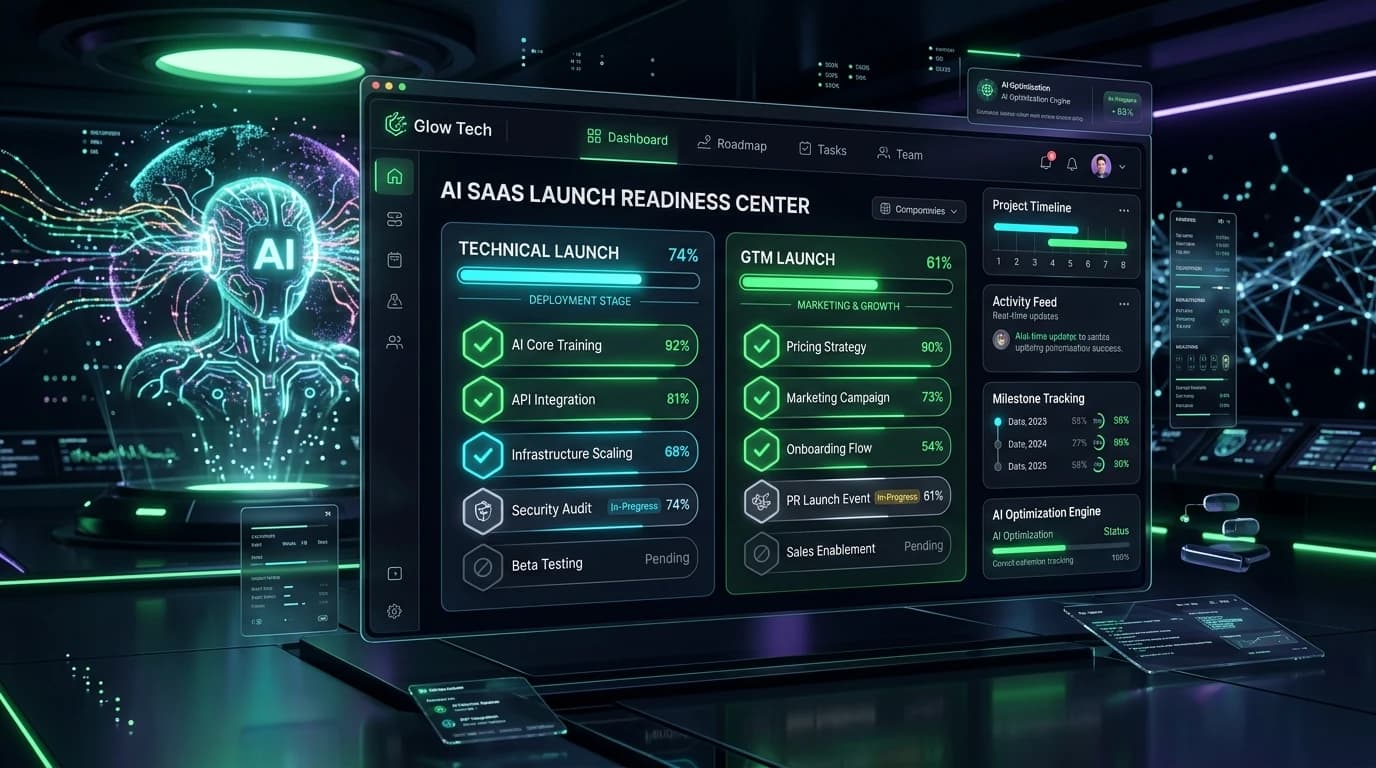
Launch Readiness: The Operational Definition
Launch readiness is the state in which a software product is technically stable, commercially positioned, and operationally capable of sustaining real users without ongoing developer intervention. It goes far beyond demonstrating functional value in controlled conditions. A launch-ready product holds up when a stranger uses it at 2:00 AM on an untested Android device, over an unstable mobile connection, with expectations shaped by mature products already dominating the market.
That definition matters because many startups launch prematurely without ever suffering a catastrophic crash or outage. There may be no public incident or day-one 500 error. Instead, early momentum simply bleeds away: visitors bounce within 15 seconds, signup conversion underperforms benchmarks, and onboarding drop-off gets misdiagnosed as "messaging failure" when unseen technical friction is the culprit. The first cohort forms an indelible first impression of a product that shipped before reaching true launch readiness.
Modern AI builders such as Cursor, Bolt.new, Lovable, v0, and Replit make achieving a demo-ready prototype extraordinarily fast. However, AI-assisted development introduces an invisible layer of risk that traditional frameworks rarely surface. This guide defines the three operational pillars of launch readiness, compares demo-ready versus launch-ready behavior across seven dimensions, and provides a structured pre-launch assessment framework before you spend a single dollar on marketing or customer acquisition.
What Does Launch Readiness Actually Mean?
Launch readiness has a much narrower, more pragmatic meaning than many first-time founders assume. It does not mean the product is finished. It does not mean every proposed feature is built, nor does it require handling every conceivable edge case in human existence. Teams that wait until their product feels "finished" drift indefinitely and never ship.
In production engineering and venture operations, launch readiness means your product can perform three specific jobs reliably:
1
Serve Strangers Without Breaking
Not your team, not friendly beta testers who know which buttons to avoid. Real users are strangers. They enter corrupted inputs, navigate backwards, double-click payment buttons, and leave sessions open across multiple browser tabs.
2
Convert Interest Into Action
A launch-ready product features an unbroken, frictionless path from the initial acquisition touchpoint (landing page, referral link, social post) to the exact moment the user experiences the product’s core value proposition.
3
Support Acquired Users
Launch readiness includes the operational machinery: self-serve onboarding, meaningful error guidance, support escalation channels, and real-time observability to catch database bottlenecks or API rate limits before users tweet about them.
The 500-Person Acid Test
Ask yourself honestly: Could you drive 500 targeted prospects to your current product today—people who have never heard your name—with absolute confidence that they would comprehend the value, successfully complete onboarding without assistance, and want to return tomorrow? If your answer is anything less than an emphatic "yes," your product has a readiness deficit that will waste acquisition capital.
The Two Core Dimensions: Technical Readiness vs. GTM Readiness
Launch readiness sits at the strict intersection of two independent tracks. Most founding teams naturally excel at one while severely neglecting the other. However, both must cross a non-negotiable minimum threshold prior to release:
⚙️
Dimension 1: Technical Readiness
The measurable certainty that your architecture, security controls, API integrations, and code will hold up under concurrent real-world usage:
- Stability Under Load: Autoscaling rules configured; database connection pooling (Supabase PgBouncer) tested against day-one traffic.
- Security & Secrets: Authentication flows hardened; secrets/service tokens strictly isolated from client-side bundles; Row Level Security (RLS) active.
- Integration Reliability: Third-party APIs (Stripe, Resend, OpenAI) resilient against rate limits, webhooks idempotently processed.
- Performance UX: Time to First Byte (TTFB) < 300ms, Core Web Vitals optimized, no uncompressed 5MB assets blocking the render tree.
- Data Governance: Compliance with GDPR/CCPA, clear privacy handling, automated database backups and verified point-in-time recovery.
- Observability: Structured error logging (Sentry), uptime alerts, and real-time dashboard telemetry active in production.
🎯
Dimension 2: GTM Readiness
The commercial alignment ensuring your product reaches the exact right audience with an irresistible value proposition and frictionless conversion:
- Positioning Clarity: Your product occupies an unambiguous, defensible position in your buyer’s category frame.
- Messaging Alignment: Headlines and copy articulate tangible business outcomes rather than listing internal code features.
- Granular ICP: Target user is defined down to job title, current spreadsheet workarounds, and buying authority.
- Channel Alignment: Launch outreach focuses squarely where your ICP makes purchase decisions, not where it’s easiest to post.
- Funnel Integrity: The end-to-end user path from landing page hero to signup to first "aha" moment is self-explanatory.
- Launch Sequencing: Momentum sequenced intentionally: warm network validation → early social proof → public press/launch spikes.
⚠️ Distinct Risks in AI-Built Products (Cursor, Bolt.new, Lovable)
Code generated by Large Language Models consistently passes "happy-path" manual testing, but commonly contains critical vulnerabilities in route-level authorization, database isolation (missing RLS), and API retry fallbacks. In AI-built SaaS, technical readiness requires forensic inspection of what the model omitted rather than merely verifying that the visual UI compiles.
Technical vs. GTM Readiness at a Glance
| Dimension | Primary Question | Failure Mode If Missing | Audit Deep-Dive |
|---|
| Technical Readiness | Will this product hold up when real users hit it simultaneously? | Outages, session leaks, broken webhooks, degraded latency under load | /technical-audit/ |
| GTM Readiness | Will the right customers discover it, understand it, and pay for it? | High bounce rates, zero viral loop, confusing pricing, burned ad budget | /go-to-market-audit/ |
What a Launch-Ready Product Can Do That a Demo-Ready Product Cannot
The distinction between "demo-ready" and "launch-ready" is the single most valuable mental model for software founders. AI builders allow developers to reach demo-ready in 48 hours. But mistaking demo capability for production maturity guarantees user churn. Here is the operational capability gap:
| Operational Capability | Demo-Ready App | Launch-Ready Product |
|---|
| Behavior Under Controlled Conditions | ✅ Yes: Works when builder enters expected test inputs in sequence. | ✅ Yes: Holds up under adverse network and device conditions. |
| Handling Unexpected User Input | ❌ No: Unknown edge cases trigger infinite spinners or silent crashes. | ✅ Yes: Input validation active; errors provide actionable next steps. |
| Security Under Hostile Conditions | ❌ Untested: API endpoints open; IDOR and prompt injection unmitigated. | ✅ Yes: Authentication verified server-side; RLS and CORS enforced. |
| Scalability During Traffic Spikes | ❌ No: Single database connection pool exhausts on 30 concurrent users. | ✅ Yes: Load-tested against 5x day-one traffic; connection limits tuned. |
| Value Communication to Strangers | ❌ No: Requires founder on a live Zoom call to explain the workflow. | ✅ Yes: Headline, microcopy, and UI guide user to value in < 90 seconds. |
| Operational Support & Telemetry | ❌ No: Bugs are discovered only when users complain on Twitter. | ✅ Yes: Automated alerting triggers before users notice service disruption. |
| Cold Traffic Conversion | ❌ No: Conversion requires high-touch priming and warm introductions. | ✅ Yes: Self-serve checkout, automated onboarding, and clear billing. |
Key Takeaway: Demo-ready is a crucial milestone—it proves you built something worthy of further development. The danger arises only when a founder mistakes demo functionality for launch resilience.
The Most Dangerous Assumption: "It Works for Me, So It’s Ready"
The single most common cognitive trap among startup builders is believing that because the product functions smoothly on their local machine and for their 10 close beta testers, it is ready for public release.
This assumption fails universally because you and your beta testers are fundamentally unrepresentative. You possess invisible scaffolding: you know the intended path, you instinctively avoid clicking unoptimized buttons, you tolerate latency because you built the system, and you test on premium devices over high-speed fiber internet.
Real cold users have zero tolerance. They make stay-or-abandon decisions in the first 30 to 90 seconds. Here are the three destructive patterns this insider assumption produces:
1. Onboarding Built for Knowledgeable Insiders
Steps that appear obvious to the founder require mental exertion from a stranger. Without structured pre-launch testing with people who have zero context, onboarding flows routinely suffer 60%+ abandonment rates on day one.
2. Cryptic, Unactionable Error Messages
When an API timeout occurs, developers recognize the error. Cold users simply see a generic error toast or an unresponsive submit button with no guidance on how to recover. They close the tab forever.
3. Messaging Focused on Technology Rather Than ICP Outcomes
Founders love explaining how their product works (models, vector embeddings, architecture). Customers only buy what the product changes for their daily workflow. A launch-ready product frames messaging entirely around buyer pain points.
The antidote to founder bias is not running more internal test runs. It is subjecting the product to structured external evaluation against real-user operational standards.
How to Assess Launch Readiness Before Spending on Marketing
Evaluating launch readiness should follow a tiered methodology. We recommend a three-level framework moving from immediate self-inspection to automated surface auditing, culminating in rigorous expert review:
Level 1
Self-Assessment Readiness Checklist (1–2 Hours)
Run through these 12 questions with complete intellectual honesty. Look for reasons to delay rather than confirmation bias:
Technical Dimension Questions:
- Have you simulated 5x expected day-one traffic using a tool like k6 or Artillery?
- Can you map every third-party API and document the exact UI failure state for each?
- Have you executed a dependency CVE scan (e.g.
npm audit) in the last 30 days? - Are error monitoring and real-time alerts active on production servers?
- Have you verified user privacy policies and cookie consent against GDPR/CCPA standards?
- Has an external engineer or security tester attempted to break authentication?
GTM Dimension Questions:
- Can you define your Ideal Customer Profile in one sentence as a specific persona?
- Has an unguided prospect matching that ICP completed onboarding successfully?
- Does your landing page convert cold visitors without anyone explaining it?
- Is pricing packaged around buyer ROI rather than internal server costs?
- Do you have an ordered launch schedule with channel-specific rationale?
- Have you defined the single primary metric that signifies launch traction within 48 hours?
Honest Caveat: Self-assessment surfaces known blind spots. If your answer to any question is "I think so," treat it as an unverified risk until documented with empirical proof.
Level 2
Automated Surface Scan (Instant • Free)
An automated scan validates the public perimeter of your web application. It examines SSL configurations, exposed HTTP security headers, Core Web Vitals performance, metadata hierarchy, and SEO baseline health in seconds.
Run Launchieve’s Free Launch Readiness Scan as an immediate first checkpoint. Any flagged high-severity vulnerabilities must be remediated before committing capital to customer acquisition.
Level 3
Full Launch Readiness Audit (5–7 Business Days)
A human-led audit combines comprehensive codebase inspection with strategic commercial positioning analysis. Independent engineers test API failure boundaries, stress-test database query efficiency, verify Row Level Security rules, and audit positioning copy against direct competitors.
Deliverables include an executive risk register, severity-ranked remediation roadmap, and a 30-day pre-launch plan. This provides the highest possible confidence before onboarding paid subscribers or pitching institutional venture investors.
Assessment Method Comparison
| Assessment Method | Turnaround | Coverage & Scope | Best Stage |
|---|
| Self-Assessment Checklist | 1–2 Hours | Known blind spots; initial team alignment on missing features | Early prototypes; pre-alpha internal milestones |
| Automated Free Scan | Instant | Surface technical health: SSL, headers, Core Web Vitals, SEO tags | Pre-launch sanity check before deeper review |
| Full Launch Readiness Audit | 5–7 Business Days | Full code inspection, auth hardening, load resilience & GTM strategy | High-stakes launches; investor demos; paid acquisition |
FREE PRE-LAUNCH SCANNERFind Out Where Your Product Stands in 2 Minutes
Uncertain whether your web application is genuinely launch-ready or hiding critical surface flaws? Run our automated diagnostic scan right now. It takes less than 120 seconds to uncover security header omissions, latency bottlenecks, and metadata misconfigurations.
Frequently Asked Questions
What is launch readiness?
Launch readiness is the state in which a software product is technically stable, commercially positioned, and operationally capable of sustaining real users. It goes beyond controlled-condition demos. Two core dimensions define it: technical readiness, meaning the product holds up under unexpected real-world usage and load; and GTM readiness, meaning the right people can find, understand, and purchase it. A product is launch-ready only when both dimensions clear their baseline requirements.
How does demo-ready differ from launch-ready?
A demo-ready product works correctly under controlled conditions with a knowledgeable user following the intended happy path. A launch-ready product works when an impatient stranger uses an unexpected mobile device, enters malformed data, and receives no live guidance from the builder. Typical gaps include missing edge case handling, opaque error states, exposed secrets, unhardened authentication, load bottlenecks, and messaging incapable of communicating value in under 90 seconds.
How do you measure if a product is ready to launch?
Launch readiness is measured across two distinct tracks. Technical readiness: infrastructure load-tested against day-one spikes, authentication verified server-side, third-party APIs tested against failure modes, observability and error logging live, and compliance regulations met. GTM readiness: ICP defined with precision, messaging tested with target prospects, self-serve onboarding validated end-to-end, and launch channels sequenced. Founders can start with our free automated scan for surface health, followed by a full technical audit before release.
L
Launchieve Technical Review Team
Technical Audit Engineers
We review AI-built codebases across security, infrastructure, APIs, and launch readiness. Our team has audited products built with Cursor, Lovable, Bolt.new, Replit, Supabase, Firebase, and mixed AI-assisted workflows. Every finding in this article comes from patterns observed in real technical reviews — not theoretical scenarios.