What Automated Launch Scans Are Good At
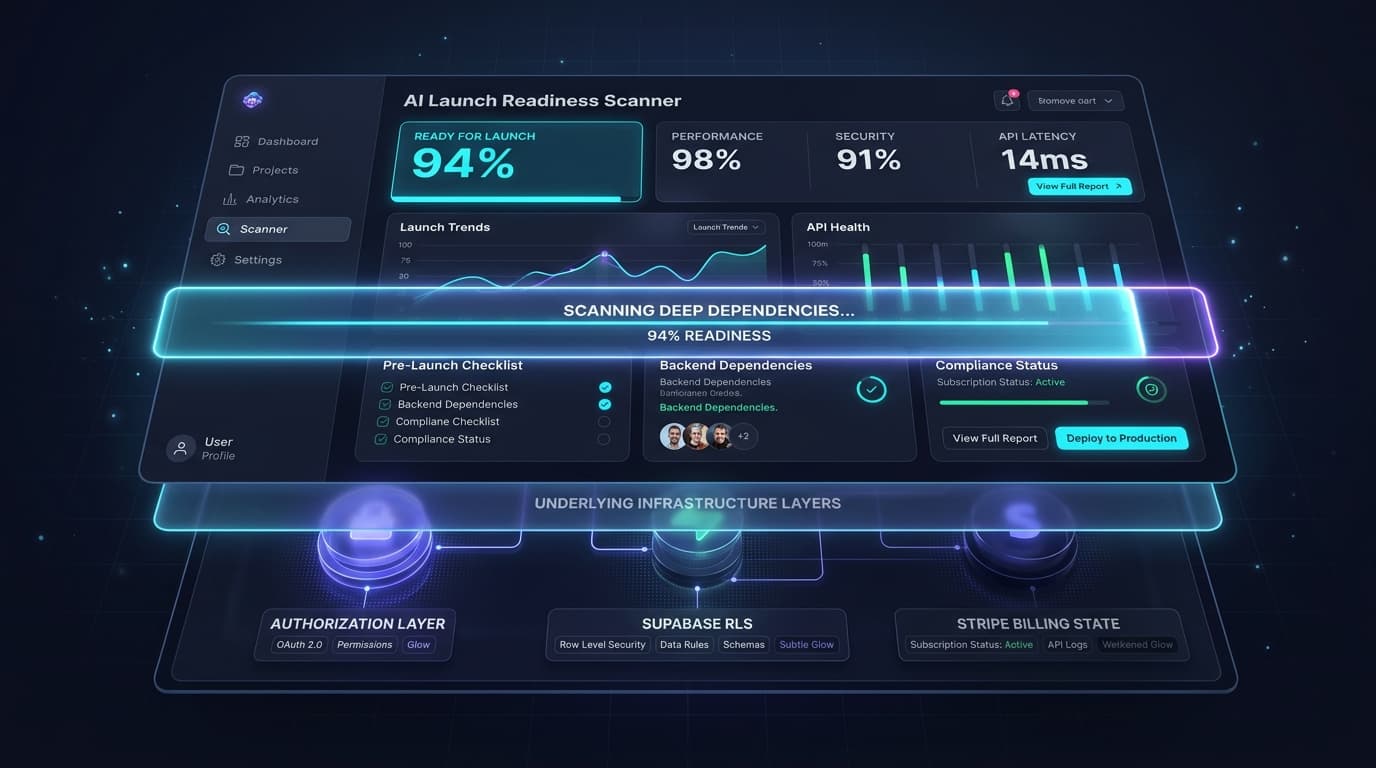
Used honestly, scanners (including AI-assisted surface scans) help you accelerate visibility across accessible layers:
| Strength | Example Signals |
|---|
| Speed | Minutes to a comprehensive first pass |
| Breadth on Public Surface | Marketing pages, public app routes, exposed assets |
| Consistency | Uniform checks run identically every single time |
| Early Triage | “Something looks off in onboarding copy / performance / exposed patterns” |
| Documentation of the Obvious | Catches issues founders stopped seeing due to familiarity |
| Input Flexibility | Live URL, staging preview, public repo, or uploaded files |
Launchieve’s own Free Launch Readiness Scan is explicitly positioned as an AI-assisted surface scan of accessible GTM and technical signals—not a full audit, not a certification, with no credit card theater.
Key Takeaway: Scanners excel at attention direction. They do not replace adversarial proof on authenticated, multi-tenant, money-moving paths.
Seven Issue Classes Free Scanners Typically Miss
These classes show up repeatedly in human launch reviews of AI-assisted codebases:
1. Authenticated Authorization Failures (IDOR and Friends)
A crawler logged out—or as a single synthetic user—will not systematically prove that user A cannot read or mutate user B’s records by swapping IDs, workspace slugs, or tickets. Many vibe-coded APIs trust client claims once an auth token exists.
2. RLS & Security Rules Correctness
Supabase Row Level Security and Firebase rules require dual-user, dual-tenant adversarial reasoning. “Table exists” or “auth is enabled” is not proof that policies deny correctly across update, delete, private storage buckets, and realtime subscriptions.
3. Webhook Trust and Billing State Machines
Webhook signature verification, retries, idempotency, past_due handling, refunds, and seat revocations live completely off the public UI. Scanners cannot execute Stripe webhook event paths against your production database logic.
4. Entitlement Bypass and Business Logic Abuse
Client-enforced feature flags in the UI, hidden unauthenticated routes, coupon loopholes, trial extensions, and debug admin endpoints leftover from Cursor/Claude sessions are logic problems—not detectable HTML errors.
5. Agent, Cron, and Integration Over-Permission
AI automations running with personal founder tokens, overly broad service keys, and prompt-injection-vulnerable tool calling are invisible to surface home-page snapshots.
6. True Conversion Friction in Context
Heatmaps and copy linters approximate UX, but they do not know your ICP’s vocabulary, whether the “aha moment” fulfills the marketing ad promise, or whether onboarding demands six complex integrations before delivering value. GTM judgment remains human. (Read our SaaS GTM Strategy Guide).
7. Prioritization Under Your Constraints
Automated tools emit un-sequenced issue lists. Founders need risk sequencing: what blocks launch vs what can safely wait, given your channel plan and risk tolerance. That is audit work, not crawl work.
For security-specific failure modes and mitigations, read Vibe Coding Security Risks.
Automated Surface Scan vs Human Launch Audit
| Dimension | Automated / Free Scan | Human Technical Audit | Human GTM Audit |
|---|
| Access Depth | Public / accessible inputs | Repo + staging under NDA | Product + messaging + funnel context |
| Authz Proof | Weak | Strong | Indirect (via conversion) |
| Billing Paths | Weak | Strong | Offer / pricing clarity strong |
| UX / Copy | Surface cues | UX risk as engineering sees it | Core focus |
| Output | Snapshot & triage signals | Prioritized technical risk dashboard | Positioning & launch direction |
| Best Moment | Anytime, early, often | Pre-customers, pre-ads, pre-demos | Pre-spend or when traction stalls |
Decision Tree: Scan, Fix Yourself, or Hire a Human Audit
Need a quick read on visible signals? Holding private user data, payments, or multi-tenant workspaces? About to spend on paid ads or email blasts? Investors or enterprise prospects demand security confidence?→ An NDA-backed human audit trail with remediations beats automated scanner badges.
Product stuck in a “one prompt fix breaks another” loop?→ Stabilize engineering first with
Complete My App before auditing moving code.
Solo founder, pre-revenue, private beta with non-sensitive data? Key Takeaway: Escalate to humans when impact × uncertainty is high (money, private customer data, reputation, or ad spend)—not when you merely want a superficial green score.
What Launchieve’s Free Launch Readiness Scan Is (and Is Not)
✓ What It IS
- An AI-assisted surface scan of accessible technical and GTM signals
- Available with website URL (plus optional repo/files for added context)
- Dual modes oriented around GTM clarity (understand, trust, act) and technical readiness
- A founder-friendly snapshot mapping potential friction points and suggested fixes
- A valuable first triage step before deciding on human code review
✕ What It IS NOT
- A formal cybersecurity penetration test
- A 100% guarantee of zero vulnerabilities or guaranteed market fit
- A substitute for an NDA-backed manual code review
- Proof that Stripe entitlements and database RLS hold under load
- An excuse to skip live testing with real strangers
Mid-funnel honesty matters: if your free scan snapshot looks clean, you may still only be demo-ready. If it flags several warnings, a human review confirms whether they are genuine launch blockers or minor cosmetic notices.
Inside the Technical Launch Audit (When You Outgrow Scanning)
When uncertainty carries high financial or reputational stakes, Launchieve’s Technical Launch Audit delivers deep human engineering verification:
1
NDA Signed First — Complete mutual NDA executed before any sensitive repo or configuration access.
2
Secure Scoped Access — Read-only repository access, staging environment, and environment configuration.
3
Manual Senior Developer Review — Hands-on code inspection across infrastructure stability, database rules, authz ownership, API keys, and scalability stress points.
4
Actionable Audit Delivered — Clear executive dashboard highlighting launch blockers, risk severity, and concrete remediation code.
Supported stacks in active audit practice: React, Next.js, Node.js, Supabase, Firebase, PostgreSQL, MongoDB, Bubble, Replit, Lovable, Bolt.new, and Cursor-generated repositories.
How to Get Maximum Value from Any Free Scan
- Scan the production-like URL: Don’t scan an outdated landing page if users interact with an app subdomain.
- Select your focus mode deliberately: Pick technical mode if stability/auth is your concern; pick GTM mode if conversion is lagging.
- Reproduce every flag manually: Treat automated scanner output as triage clues, not definitive verdict.
- Map flags to your dual-track checklist: Align items to your Launch Checklist.
- Run tests a scanner cannot perform: Dual-user data access tests, Stripe webhook sandbox tests, and unassisted stranger usability tests.
- Re-scan after major architecture changes: Re-audit whenever dependencies, auth providers, or payment rails change.
Frequently Asked Questions
What do free launch scanners miss most often?
Authenticated authorization bugs (IDOR), correct Row Level Security (RLS) policies, billing webhook verification, client-enforced entitlement bypass, over-permissioned AI agents, and ICP-specific conversion friction.
Are free scanners worthless?
No. They are excellent for fast surface triage, catching broken assets, and overcoming founder blindness. They are only dangerous when treated as sole proof of security.
Is Launchieve’s free scan a full audit?
No. It is an AI-assisted surface snapshot of accessible signals. Our human audits go substantially deeper under NDA with senior engineers.
When should I order a human Technical Launch Audit?
Before collecting real customer data, scaling paid acquisition, launching publicly on Product Hunt/Hacker News, or demoing to investors with live data.
When is a GTM audit the better next step?
When users can navigate the software without technical errors, but drop off during onboarding or fail to understand the pricing and core value proposition.
Can automated scanners replace penetration tests?
No. Penetration tests and manual code reviews are specialized disciplines requiring active vulnerability exploitation. Scanners provide early smoke signals.
What if I only have a private repository?
You can upload code files during the scan or book an NDA-backed Technical Launch Audit for direct GitHub repository inspection.
Should I scan before or after my own checklist?
Run a quick self-pass on basic flows first, use the free scan to uncover blind spots, and re-scan following major technical remediations.
Action PlanUse Scanners for Signals, Humans for Stakes
Run a free launch readiness scan to catch visible signals, or order a human Technical Launch Audit to secure your product before real customers arrive.
L
Launchieve Technical Review Team
Technical Audit Engineers
We review AI-built codebases across security, infrastructure, APIs, and launch readiness. Our team has audited products built with Cursor, Lovable, Bolt.new, Replit, Supabase, Firebase, and mixed AI-assisted workflows. Every finding in this article comes from patterns observed in real technical reviews — not theoretical scenarios.