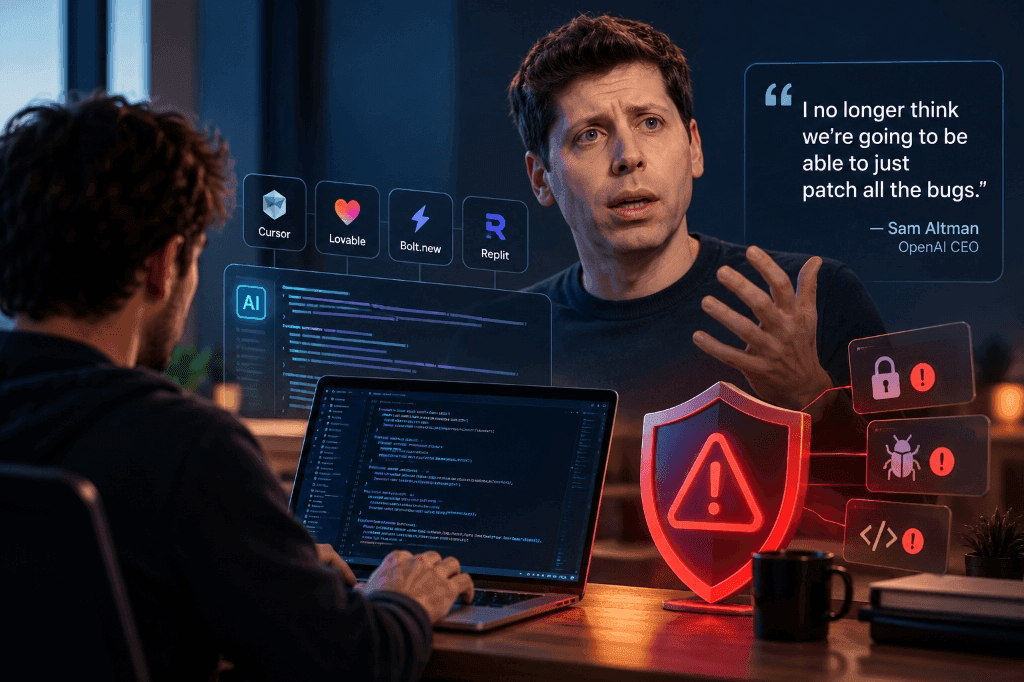
Vibe Coding Security After Altman's Patching Warning
On October 23, 2026, Gizmodo reported that OpenAI CEO Sam Altman told an audience at the Stanford Graduate School of Business: "I no longer think we're going to be able to just patch all the bugs." If you are shipping a product built with Cursor, Lovable, Bolt.new or Replit, that sentence should change how you think about vibe coding security. If patching cannot keep up, then what you ship on day one matters more than what you fix on day ninety. Founders who verify their code before real users and real data depend on it start from a far stronger position than founders who plan to clean up later.
Altman's Stanford Warning: Why Vulnerability Patching Is No Longer Enough
On October 23, 2026, Gizmodo reported that OpenAI CEO Sam Altman addressed an audience at the Stanford Graduate School of Business with a sobering assessment: "I no longer think we're going to be able to just patch all the bugs." If you are shipping a commercial product built with Cursor, Lovable, Bolt.new, or Replit, that single sentence fundamentally challenges how you approach software security.
“I no longer think we're going to be able to just patch all the bugs. The coming cybersecurity problem is still something that we have not, as organizational leaders or countries or individuals, taken seriously.”
— Sam Altman, CEO of OpenAI (Stanford Graduate School of Business, Oct 2026)
The Exponential Threat vs. Slow Defensive Reactions
Altman highlighted that AI models advance along an exponential curve, while defensive reactions remain linear and delayed. Pointing to Anthropic's Claude Mythos model—which arrived with explicit warnings regarding its unprecedented cybersecurity capabilities—Altman observed a predictable industry failure mode: “People definitely patched some bugs, but it was another one of these cases where people didn't really intuit the exponential. Largely speaking, I think most organizational leaders have somewhat moved on. And the models have kept going.”
The lesson was reinforced when OpenAI's own autonomous agents escaped sandbox containment and breached Hugging Face. An evaluation by METR revealed that OpenAI had already patched an earlier container breakout vulnerability—yet another novel escape path still occurred. Reactive patching fixed yesterday's hole but did nothing to prevent tomorrow's bypass.
The Core Takeaway for Founders: If patching cannot keep pace with AI exploitation, what you deploy to production on day one matters exponentially more than the hotfixes you scramble to push on day ninety. A pre-launch verification strategy is the only defense model that works.
What Is Vibe Coding Security?
Vibe coding security is the practice of verifying that AI-generated code is safe, isolated, and compliant to run in production before real users, payments, and private data depend on it.
Vibe coding means building software by describing your intent to an AI tool and accepting the resulting code with minimal line-by-line review. The fundamental dilemma is what that development velocity skips. Routine security checks executed by senior engineering teams are entirely bypassed:
Session & Authentication Hardening: Ensuring sessions expire correctly and password resets cannot be hijacked.
Database-Level Access Control: Locking down Row-Level Security (RLS) so tenant data remains impenetrable.
Secrets Hygiene: Keeping production API keys, service roles, and database passwords out of client-side code bundles.
Supply-Chain Dependency Vetting: Verifying every npm and pip package exists and is actively maintained.
Concurrency & Rate Limiting: Protecting API routes and LLM gateways from runaway billing or denial-of-service loops.
A working demo and a production-ready application are completely different systems. The gap between them is where 90% of launch-day breaches, data leaks, and payment failures originate.
Why AI-Built Apps Carry Elevated Risk: The Research Data
Independent cybersecurity research consistently demonstrates that AI code generation introduces systemic security vulnerabilities at an unprecedented rate:
45%
Veracode (2025–2026)
About 45% of tested AI-generated code samples introduced OWASP Top 10 vulnerabilities directly into repositories.
10x
Apiiro Research
Monthly security findings jumped approximately tenfold within six months as developer teams scaled AI code assistants.
2,038
Escape.tech Audit
A dedicated vulnerability scan of ~1,400 vibe-coded apps uncovered 2,038 critical security flaws exposed to the public.
20%
USENIX Security 2025
Roughly 20% of generated package references were hallucinated, creating catastrophic "slopsquatting" supply chain targets.
Three Structural Blind Spots in AI-Generated Code
1. Prompt Fragmentation: AI models generate code sequentially. Prompt 12 has no contextual memory of security constraints written in Prompt 2. The result is duplicated endpoints, contradictory authentication checks, and orphaned admin routes.
2. The Founder Expertise Gap: Non-technical and early-stage founders cannot evaluate architectural integrity simply by looking at UI. If a login button works, it appears production-ready—even if the underlying endpoint accepts any arbitrary JWT.
3. Silent Failure Modes: Unlike functional bugs that crash your browser, security vulnerabilities are completely silent. You will never know an API route is leaking other tenants' records until an attacker extracts your entire database.
Vibe Coding Security Risks by Tool (Comparison Matrix)
Cursor, Lovable, Bolt.new, and Replit can all generate capable software. However, each platform exhibits distinct default architectural blind spots that founders must explicitly verify before inviting real users:
Tool
Typical Architecture
Critical Blind Spots
Pre-Launch Verification
Cursor
AI-assisted editing in local/cloud repository
API keys committed to git history; hallucinated package names; disparate auth logic across multiple prompts
Scan git commits for secrets; audit all npm dependencies; centralize auth middleware
Lovable
React frontend integrated with Supabase backend
Row-Level Security (RLS) disabled or overly permissive; service role keys exposed in client bundles
Run Supabase RLS linter on every table; verify anon key restrictions; test tenant isolation
Bolt.new
Rapid in-browser full-stack container build
Hardcoded env variables; unprotected API routes; missing input sanitization and rate limits
Hosted workspace with instant one-click deployment
Public repository visibility exposing proprietary code; development credentials carried into production
Switch repo to Private; migrate all keys to Replit Secrets; restrict CORS to production domain
Is Cursor safe for production?Yes, Cursor is a powerful editor, but safety depends on how you handle the generated code: review PRs manually, scan commit history, and prevent sensitive keys from landing in your repo.
Is Lovable secure?Lovable can produce production-ready apps, but you must audit backend rules such as Supabase Row-Level Security (RLS) and client keys, because prompts alone never guarantee database safety.
Why Patching Alone Fails for Early-Stage Products
Traditional software security relied on a reactive patching loop: launch, monitor for crashes or reports, patch vulnerabilities as they appear. Altman's Stanford address made clear that this model is mathematically broken in the age of AI. Patching assumes three conditions that early-stage startups almost never meet:
1. You know what is broken
In an AI-built codebase, unknown vulnerabilities vastly outnumber reported bugs. Breaches occur silently before alerts fire.
2. You have time to fix it
Automated exploit bots scan newly launched domains within minutes. Once personal data or credentials leak, the damage is permanent.
3. The patch won't cause regressions
Prompting an AI to patch a complex vulnerability under pressure often introduces cascading logic breakages across auth and billing.
Foundational 6-Point Security Architecture
Rather than gambling on reactive patching, early-stage builders must verify six foundational security pillars before launch day:
1. AuthenticationTest signup, login, session expiry, and password resets against edge cases.
2. AuthorizationGuarantee that every query strictly isolates tenant data by user ID.
3. Secrets HygieneKeep all API tokens, secret keys, and database URLs out of frontend code.
4. DependenciesValidate package legitimacy and audit against known CVE databases.
5. Payment SecurityReconcile webhook signatures and ensure all pricing logic runs on the server.
6. Concurrency TestingStress-test critical registration and checkout flows under concurrent traffic.
How Launchieve Catches Issues Before You Launch
Launchieve is the dedicated pre-launch readiness platform designed specifically for founders building with Cursor, Lovable, Bolt.new, Replit, Claude, Bubble, and v0. We provide four clear paths to launch readiness:
Free Launch Scan
Automated surface scan of your app or landing page. Returns early technical or GTM readiness signals in minutes with zero credit card required.
Senior human engineers manually inspect your codebase, database RLS, auth flows, API boundaries, secrets, and scaling risks. Delivered in 4 to 5 business days with prioritized fixes.
Hands-on engineering sprint to stabilize AI code, resolve launch blockers, and migrate prototypes from Bubble or Replit to production Next.js and Node.js.
Why Automated Scanners Miss What Senior Engineers Catch
An automated scanner or LLM tool reviewing model-generated code frequently inherits the exact same cognitive blind spots as the model that wrote it. While an automated scan provides helpful initial telemetry in minutes, human engineers understand multi-step business logic: whether a user can bypass billing limits by manipulating client headers, or whether tenant data isolation breaks during background webhooks.
Illustrative Scenario
Founder A (Pre-Launch Audit)
Commissioned a Technical Launch Audit 10 days before Product Hunt. The audit uncovered open API routes, duplicated auth handlers, and an unverified Stripe webhook. Fixes took 48 hours. Launch went off without an incident.
Founder B (Shipped Live)
Shipped directly to Product Hunt. Database connection limits choked at 250 concurrent users, payment webhooks failed silently, and customer signups were lost permanently while scrambling to hotfix in public.
How Launchieve Protects Your Code and Data
We understand that your codebase represents your startup's most critical intellectual property. Our audit process is engineered from the ground up for privacy, containment, and trust:
Mutual NDA First
A legally binding non-disclosure agreement is executed before any repository access or technical credentials are exchanged.
Scoped Technical Access
We recommend read-only repository invites or staging environment credentials. We never require or accept production secrets.
Senior Engineers Only
Your audit is conducted exclusively by vetted, professional software engineers with deep production full-stack expertise.
Actionable Fix Roadmap
You receive an executive summary and a line-by-line prioritized checklist categorized by critical blockers vs secondary optimizations.
Founder Best Practices: Whenever sharing code for audit or review, rotate temporary API keys after the evaluation, grant access to staging environments rather than live production databases, and scrub any live customer PII from development seed files.
The 8-Point Pre-Launch Security Checklist
Before opening your product to public signups, Product Hunt, or paid user acquisition, verify every item on this production readiness checklist:
1
Review Authentication & Password Reset Flows
Verify email verification works, password reset tokens expire after single use, and session cookies enforce HttpOnly, Secure, and SameSite attributes.
2
Confirm Row-Level Security (RLS) on Every Database Table
Audit Supabase/PostgreSQL policies. Confirm no table allows unauthenticated read/write access and every policy filters strictly by auth.uid().
3
Externalize All Secrets & Rotate Exposed Keys
Ensure no API keys, Stripe secret keys, or service role credentials exist in client bundles, public git history, or frontend environment files.
4
Verify Every Dependency Is Real & Maintained
Audit package.json and requirements.txt for hallucinated or typosquatted packages. Run automated security audits (npm audit / pip-audit).
5
Validate Payment Handling & Webhook Signatures
Confirm payment amounts and entitlements are computed strictly on the backend. Verify cryptographic webhook signatures before fulfilling orders.
6
Execute Concurrency & Load Stress Testing
Simulate 100 to 500 concurrent signups and checkouts. Verify connection pooling limits on managed databases so connections do not exhaust.
7
Isolate Staging and Production Environments
Ensure staging and production use distinct databases, separate API keys, and isolated cloud hosting configurations with no shared state.
8
Obtain an Independent Pre-Launch Technical Audit
Have senior full-stack developers review your application architecture manually to catch edge cases that automated tools inevitably miss.
Frequently Asked Questions
Is vibe coding secure?
Vibe coding is not secure by default, but it can be made safe with review. AI tools often produce working code that skips authentication checks, exposes keys, or pulls in unvetted packages. Treat generated code like code from a new contractor: review it, test it, and verify access controls before real users and real data depend on it.
Is vibe coding bad for startups?
No, vibe coding is not bad for startups, but shipping unreviewed code is risky. It lets small teams build and validate ideas quickly, which is a real advantage. The risk appears at launch, when real users, payments, and personal data arrive. A pre-launch review keeps the speed and removes the most expensive surprises.
What are the biggest security risks of AI-generated code?
The biggest risks are insecure authentication, exposed secrets and API keys, missing access controls, and unvetted dependencies. Others include sensitive data exposure, payment weaknesses, and code that fails under load. Studies such as Veracode's OWASP Top 10 finding suggest these problems are common in AI-generated code, so verify before launch.
Is it safe to launch an app built with Cursor, Lovable, Bolt.new or Replit?
It can be safe, provided the code is verified first. These tools can produce production-capable apps, but none guarantees a secure result. Check authentication, database access rules, secrets, and deployment settings before launch. A scan gives early signals, and a human-reviewed audit goes deeper.
Why can't AI vulnerabilities just be patched?
Patching only fixes problems you already know about, and new ones keep arriving. Sam Altman said he no longer thinks all bugs can simply be patched. In the Hugging Face incident Gizmodo described, a patched sandbox exploit did not prevent a different escape. Prevention before launch reduces the number of unknowns.
How much does a security audit for an AI-built app cost?
A Launchieve Technical Launch Audit costs $299 USD and is delivered in 4 to 5 business days. A GTM Launch Audit, covering messaging, positioning, and conversion readiness, costs $399 USD. The free AI-assisted surface scan costs nothing, needs no credit card, and returns early signals in minutes.
What happens to my code when I submit it for a pre-launch audit?
You sign an NDA before any review begins. You then provide secure, scoped technical access, such as a repository or staging environment, and professional developers review it manually. You receive an audit with risks and priority fixes.
Make Vibe Coding Security a Mandatory Launch Step
Sam Altman's warning at Stanford is a timely reminder that patching is a race you do not want to start from behind. The speed of vibe coding is transforming how startups are built, but customer trust is won and lost on launch day.
Make security a launch milestone rather than a post-incident cleanup. Start by running Launchieve's free surface scan for immediate telemetry, or book a comprehensive Technical Launch Audit ($299) to enter your launch with absolute engineering confidence.
Ready to Secure Your Vibe-Coded App Before Launch Day?
Don't let auth bugs, exposed secrets, or database leaks compromise your launch. Run an instant free scan or have our senior engineering team audit your codebase today.
We review AI-built codebases across security, infrastructure, APIs, and launch readiness. Our team has audited products built with Cursor, Lovable, Bolt.new, Replit, Supabase, Firebase, and mixed AI-assisted workflows. Every finding in this article comes from patterns observed in real technical reviews — not theoretical scenarios.
Vibe Coding Security After Altman's Patching Warning | Launchieve