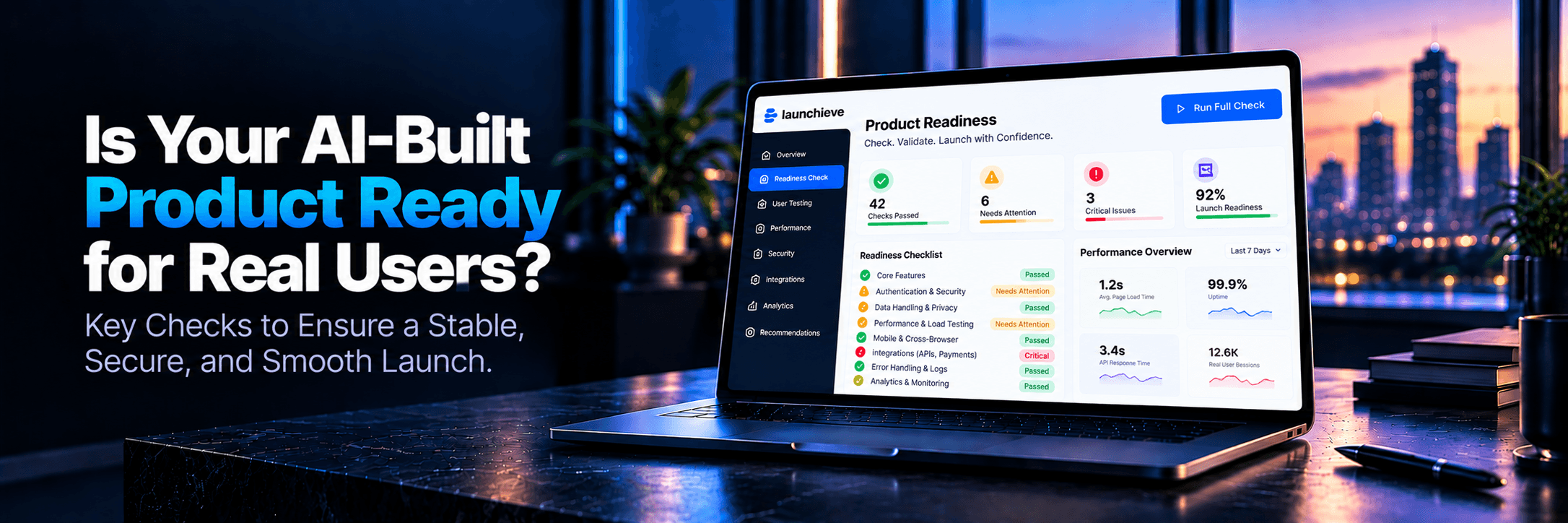
Work through each item before opening the gates to strangers. Built specifically for AI product launches on tools like Cursor, Lovable, Bolt.new, Replit, and Claude.
1
Core user flows work end-to-end
Don’t just test happy paths. Map every step from sign-up to value delivery with empty states, long text, and unexpected characters. If you don’t break your product, first users will.
✓ Target:Tested with 20+ non-standard inputs, edge characters, and mobile viewports.
2
Onboarding sets accurate expectations
First impressions determine trust. Your copy must clearly state what the AI does, what it cannot do, and where human review is needed. Audit onboarding for promises the model cannot keep.
✓ Target:No "magic" over-promises; explicit guardrails on product capabilities in first-run screens.
3
Data quality & RAG sources verified
If using embeddings, knowledge bases, or fine-tuning, audit data freshness and bias. Outdated or corrupted context documents are the #1 cause of bad outputs in production.
✓ Target:Spot checks completed across all retrieval sources; empty/missing document fallbacks tested.
4
Model accuracy benchmarked against 50–100 scenarios
Define what "good enough" means with measurable criteria. Run at least 50–100 test scenarios with expected outcomes and track divergence rates.
✓ Target:Acceptable error rate under 5%; catastrophic error rate strictly 0%.
5
Hallucination risk addressed with UI guardrails
Every LLM hallucinates under edge pressure. Add output confidence indicators, citations, source references, and "verify this" warnings on high-stakes outputs.
✓ Target:Disclaimers and citation links visible where factual accuracy is mission-critical.
6
Error handling is user-friendly (No raw 500s)
Map every failure state: timeouts, rate limits, content filters, and empty model returns. "Something went wrong" is unacceptable — give users actionable next steps.
✓ Target:Custom UI fallback cards with retry/rephrase buttons on every AI route.
7
User feedback loops in place
Real users will discover failure modes you never anticipated. Put a simple thumbs up/down and "report issue" trigger on every AI generation.
✓ Target:Feedback logged with prompt, parameters, output, and user ID to a reviewable dashboard.
8
Security and data privacy validated
Audit what data is sent to external AI APIs. Are customer PII, keys, or proprietary prompts logged in plain text? Ensure privacy terms match actual data flows.
✓ Target:Provider zero-retention/data-sharing verified; client env variables contain zero server secrets.
9
Performance under realistic load tested
AI calls are slow (2-8 seconds). Measure latency under concurrent traffic and provide interactive loading skeletons and progress cues.
✓ Target:Loading state appears within 100ms; streaming enabled where supported.
10
Regulatory compliance verified
Confirm your AI architecture complies with applicable frameworks (GDPR, CCPA, HIPAA, EU AI Act risk categorizations).
✓ Target:User data deletion and export endpoints functional.
11
Monitoring and observability configured
Track AI response times, token consumption, cost per user, and error spikes. Set alerts for unexpected model behavior or provider degradation.
✓ Target:Telemetry live with Slack/email alerts on error spikes or latency > 10s.
12
Tested rollback and failover plan
If a provider update or prompt regression causes bad outputs, can you revert prompts or switch model versions in under 5 minutes without redeploying?
✓ Target:Model fallback version tested and traffic capping controls verified.