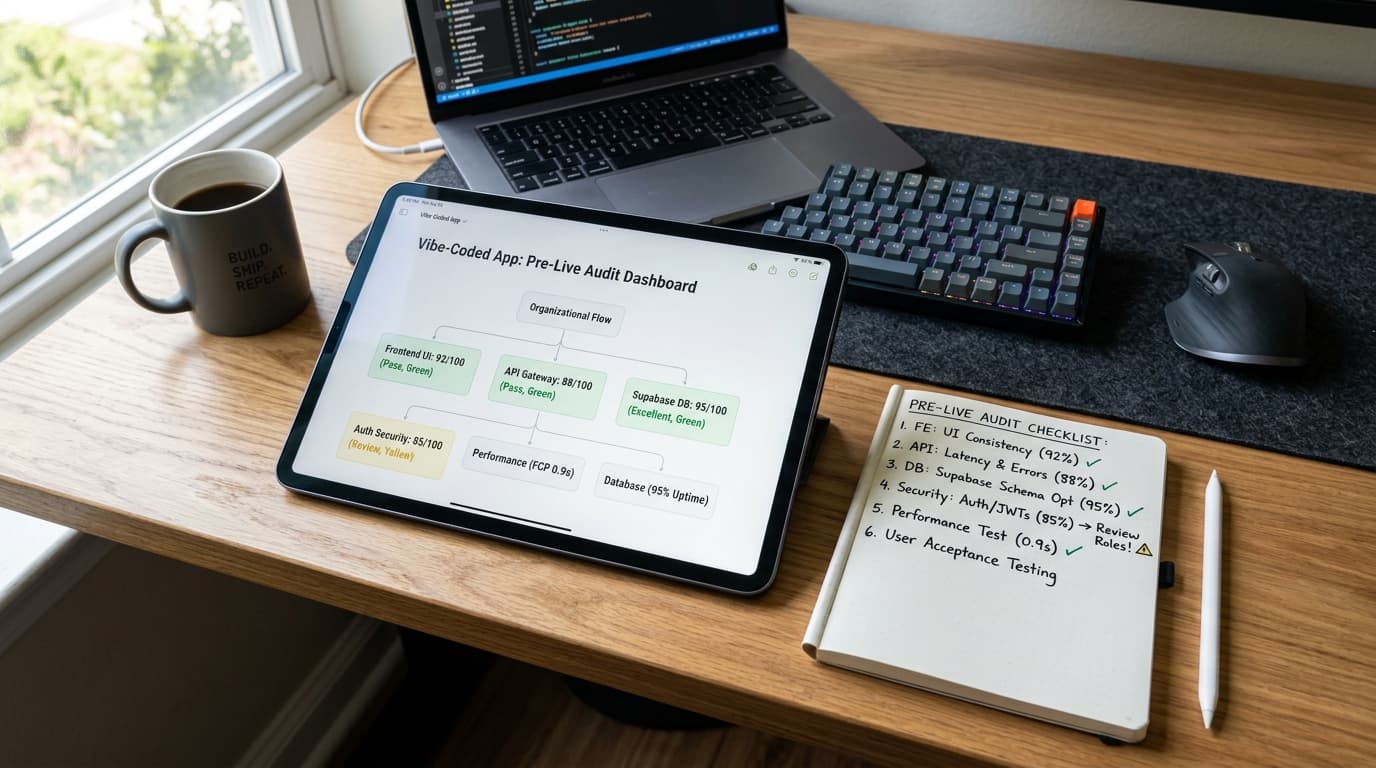
Why a Founder Audit Is Different From an Engineer Audit
You did not write the code. The AI did. You described the product, iterated, clicked, and deployed. Somewhere between “prompt” and “production,” a real product appeared—and real people are about to use it with real money.
That is the immense promise of vibe coding, but it is also where many apps stumble. Poor construction is not always the culprit; the bigger failure mode is the complete absence of verification between AI-generated output and production reality.
The Core Insight: An engineer auditing your code inspects SQL injection vectors, race conditions, and unhandled promise rejections. A founder audit uses a lateral lens: inspecting the product from the outside as an unfamiliar user. A founder audit asks: “Does this product work for a real person?” An engineer audit asks: “Will it keep working under pressure?” True launch readiness requires both views.
This guide resolves the split for every single audit item: what you can verify and fix yourself in under 90 minutes, and what genuinely requires an expert technical review.
PART 1 • TECHNICAL VERIFICATION (60–90 MIN)
Technical Signals You Can Check Without Writing Code
Every item below can be verified by a non-technical founder using just a browser, a real phone, and a test card. No code editor required.
1. Can a New User Sign Up and Log In Without Your Help?
Open an incognito window. Go to your live public URL (not localhost or preview). Create an account using an email address never registered before.
| Auth Check | You Can Verify | Who Fixes It |
|---|
| Sign-up form submits cleanly with clear message | ✓ You | You (editor / UI) |
| Confirmation email arrives in inbox (not spam) in <2 min | ✓ You | You (SMTP config) / Expert |
| Social OAuth redirect (Google/GitHub) completes | ✓ You | You (Redirect URI whitelist) |
| Session persists after 20-min idle | ✓ You | Expert (JWT/session config) |
| Wrong password error is specific and helpful | ✓ You | You (editor / copy) |
2. Is the Payment Flow Fully Functional End-to-End?
Test all three moments of truth: Before (pricing clarity), During (card submission without hanging spinners), and After (custom confirmation page + webhook database entitlement update).
| Payment Check | You Can Verify | Who Fixes It |
|---|
| Pricing page is clear and reachable when logged out | ✓ You | You (editor) |
| Card submission resolves without infinite spinner | ✓ You | You / Expert |
| Success page appears (not homepage or 404) | ✓ You | You (success_url config) |
| Paid status immediately updates inside user database | ✓ You | Expert (Stripe webhook) |
| Live transactions succeed under production keys | ✓ You | Expert (live Stripe secrets) |
3. Does Your App Produce Clear, Usable Error Messages?
Deliberately break things: submit blank forms, type broken emails, disconnect your Wi-Fi mid-submit, and visit non-existent routes like /random-page-404.
| Error State | You Can Verify | Who Fixes It |
|---|
| Empty form submission shows field-level guidance | ✓ You | You (editor / validation) |
| 404 page is branded with helpful recovery navigation | ✓ You | You (editor) |
| No raw JSON stack traces printed to user screen | ✓ You | Expert (error handling) |
| Network offline state informs user gracefully | ✓ You | Expert (error boundaries) |
4. Does Every Link, Button, and Form Work on a Physical Phone?
Never rely on browser window resizing. Open your live URL on an actual iPhone (Safari) and Android (Chrome) device.
| Mobile Check | You Can Verify | Who Fixes It |
|---|
| No horizontal scrolling on 320px–390px screens | ✓ You | Expert (CSS overflow / layout) |
| CTA buttons fully visible and tappable (≥44px targets) | ✓ You | You / Expert |
| Navigation drawer opens and closes reliably on tap | ✓ You | You (editor) |
| Inputs remain visible when virtual keyboard opens | ✓ You | Expert (viewport / scroll fix) |
5. Is Your App Served Over HTTPS Everywhere?
Check the browser address bar for a secure padlock. Type http:// before your domain and verify it automatically forces a redirect to https://.
| HTTPS Check | You Can Verify | Who Fixes It |
|---|
| Padlock visible in address bar (zero mixed content) | ✓ You | You (host config) |
| http:// automatically redirects to https:// | ✓ You | You (host / DNS redirect) |
| All static assets, scripts, fonts load over HTTPS | Partial | Expert (CSP / security audit) |
PART 2 • GO-TO-MARKET SIGNALS (60 MIN)
GTM Signals You Can Check in One Hour
An app can pass every technical test and still fail commercially. Vibe-coded products frequently lose customers due to vague hero copy, complicated pricing, or friction-heavy onboarding.
1. Can a Stranger Explain What You Do in 10 Seconds?
Send your homepage link to someone who has never seen your project. Give them exactly 10 seconds. Ask: “What does this product do? Who is it for? Why should I care?” If they hesitate, rewrite your headline immediately.
| Clarity Check | You Can Verify | Who Fixes It |
|---|
| Stranger articulates value prop correctly in 10s | ✓ You | You (rewrite headline) |
| Headline explicitly names customer and outcome | ✓ You | You (copy revision) |
| CTA button copy is action-led (e.g., “Start Free Audit”) | ✓ You | You (editor) |
2. Is Your Pricing Decision Obvious Without a Sales Call?
A self-serve SaaS pricing page must let buyers choose the right plan in under 30 seconds without decoding technical jargon.
| Pricing Check | You Can Verify | Who Fixes It |
|---|
| Target plan identifiable in <30 seconds | ✓ You | You (tier restructuring) |
| Recommended plan visually highlighted (“Most Popular”) | ✓ You | You (editor / UI) |
| Risk reversal (free trial / guarantee) prominently visible | ✓ You | You (copy) |
3. Does Onboarding Reach the Aha Moment in ≤5 Steps?
The “aha moment” is when a user first experiences the product's tangible value. Eliminate mandatory profile surveys and integration setup before that first win.
| Onboarding Check | You Can Verify | Who Fixes It |
|---|
| First post-signup action is unmistakable | ✓ You | You (editor) |
| Aha moment reachable in 5 steps or fewer | ✓ You | You + Expert |
| Leaving mid-flow restores user progress on return | ✓ You | Expert (state management) |
What a Professional Audit Checks That This Checklist Cannot
The founder checklist evaluates user experience and surface behaviors. A professional technical audit investigates the underlying architecture hidden beneath the browser:
Security & RLS Policies
Audit client-side bundles for exposed secrets, missing Supabase Row Level Security rules, and API input sanitization against SQL injection.
Database Performance Under Load
Pinpoint missing indexes, un-indexed foreign keys, and N+1 query loops before high-traffic launch spikes overwhelm connections.
Webhook & Idempotency Logic
Inspect Stripe webhook event chains, signature verification, and automated retry logic to prevent paid users from being locked out.
Dependency Vulnerability Audit
Scan installed npm packages for known CVEs pulled in during rapid AI code generation sprints.
Explore our full audit services: Technical Launch Audit and Go-to-Market Audit.
The Complete Founder Audit Checklist at a Glance
Use this master summary as your final pre-launch sign-off sheet:
| Area | Pre-Launch Verification Check | Resolution Path |
|---|
| Auth | New user sign-up + confirmation email inbox delivery | ✓ You (editor / email) |
| Auth | Social OAuth redirect (Google/GitHub) completes | ✓ You (URI config) |
| Auth | Session persists after 20-min idle | Expert (auth token config) |
| Payments | Test card completes checkout without hanging spinner | ✓ You |
| Payments | Paid status updates in app database after webhook fires | Expert (webhook signing) |
| Errors | No raw JSON stack traces visible to visitors | Expert (error handling) |
| Mobile | Zero horizontal scroll on iPhone and Android | Expert (CSS layout) |
| HTTPS | Padlock active; http:// automatically forces https:// | ✓ You (DNS / host) |
| GTM | Stranger articulates core value prop in under 10 seconds | ✓ You (headline rewrite) |
| GTM | Onboarding reaches aha moment in 5 steps or fewer | ✓ You + Expert |
Frequently Asked Questions (FAQ)
How do I audit my own app before launching?
Start with the two-part founder checklist in this guide: technical layer (auth, payments, errors, mobile, HTTPS) and GTM layer (homepage clarity, pricing simplicity, onboarding flow). Each check is achievable without writing code using a browser, a real phone, and 2–3 hours. Items flagged “Expert” belong in a professional pre-launch technical audit before any major traffic push.
What does a pre-launch technical audit include?
A professional pre-launch audit of a vibe-coded app typically covers security vulnerabilities in generated code (exposed keys, missing RLS policies, injection vectors), database performance and indexing, webhook and payment event-chain reliability, error handling and logging, mobile rendering across real device profiles, and dependency vulnerability scanning. The output is a ranked, prioritized remediation plan.
Can a non-technical founder audit their AI-built app?
Yes, and they absolutely should. The founder audit does not require code access; it requires using the product through a stranger’s lens: fresh browser session, real mobile device, test card, and honest observation. Founders frequently catch UX and messaging friction that code audits overlook.
How long does a launch readiness audit take?
The founder checklist in this guide takes 2–3 hours to complete thoroughly. A professional technical audit of a vibe-coded app typically takes 1–3 business days (usually 48 hours for a standard Lovable/Cursor app with a Supabase backend) to produce a comprehensive remediation report.
Before You Hit Publish
The question is not “is my app good enough?” The question is “have I looked at it the right way before strangers do?” Find out what needs attention before launch day.
L
Launchieve Technical Review Team
Technical Audit Engineers
We review AI-built codebases across security, infrastructure, APIs, and launch readiness. Our team has audited products built with Cursor, Lovable, Bolt.new, Replit, Supabase, Firebase, and mixed AI-assisted workflows. Every finding in this article comes from patterns observed in real technical reviews — not theoretical scenarios.