What Separates a Telehealth Demo From a Platform Patients Actually Trust
The Benchmark a Production-Grade Platform Sets
First Stop Health's public metrics give founders a useful target: 96% of visits rated a perfect five stars, average wait times under five minutes, and care delivered across urgent, mental health, and primary care with zero out-of-pocket cost for members. These aren't marketing claims. They're the result of a platform that has earned patient trust at scale through years of employer-sponsored distribution and clinical consistency. Your AI-built prototype isn't competing with a whiteboard. It's competing with that.
Why First Stop Health Sets the Uptime and HIPAA Bar
A checkout bug in an e-commerce app costs you a sale. A broken session in a telehealth app costs the patient care they need. The stakes reshape what "production-ready" means in this category. Patients expect confidentiality, reliability, and a seamless handoff from request to provider without friction or doubt.
Any visible technical issue will destroy trust immediately. A login error sends a patient elsewhere. A dropped video call doesn't get a second chance. A missing prescription record breaks confidence in the platform permanently. Users don't file bug reports. They leave and don't come back.
The Specific Gaps AI Builders Leave Behind
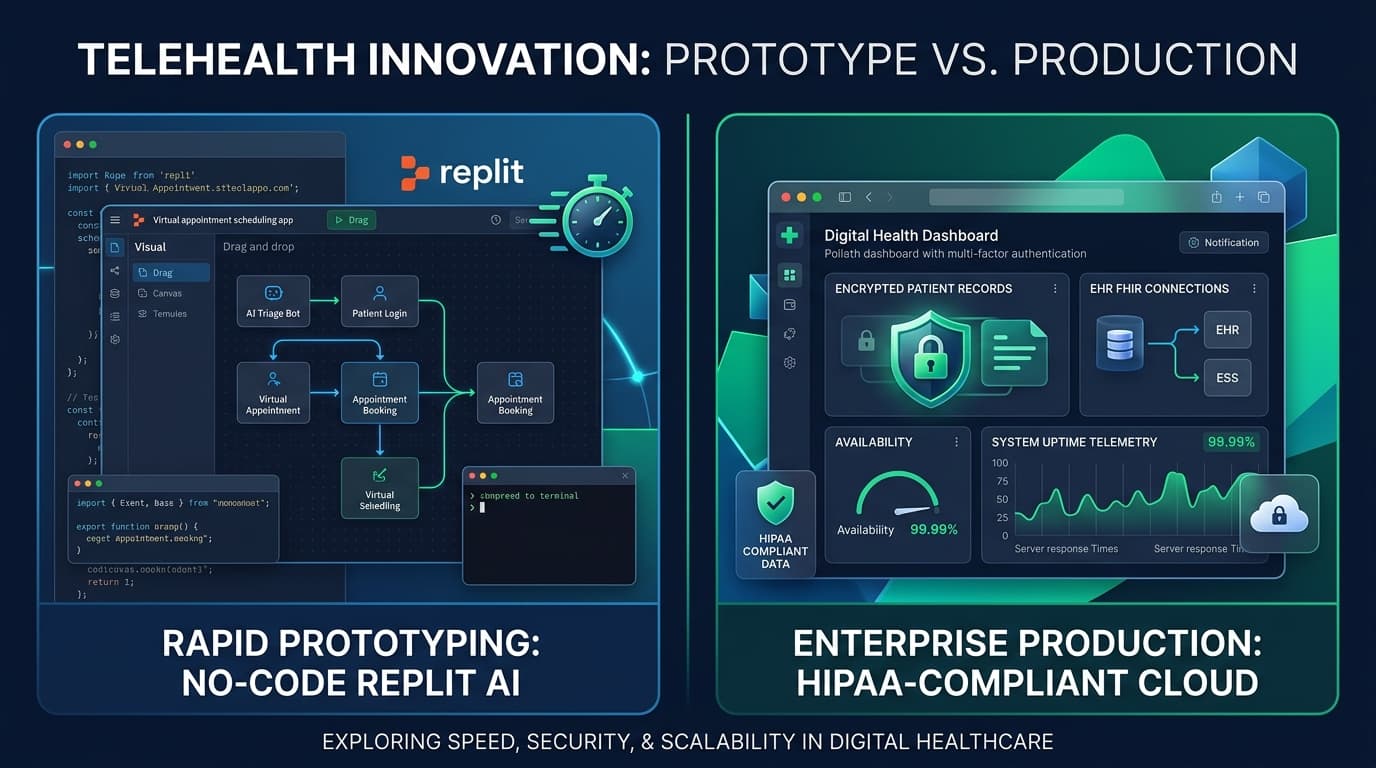
Replit and Bolt.new are genuinely powerful for standing up a functional frontend fast. What they don't handle automatically is the infrastructure layer healthcare requires: PHI data handling, audit logs, session expiration policies, and role-based access controls for providers versus patients. The working demo hides these gaps. The first real patient finds them.
What Replit and Bolt.new Actually Build Well in This Space
Where AI-Assisted Builders Add Real Value for Telehealth MVPs
AI builders excel at rapid UI scaffolding, user flow prototyping, appointment request interfaces, and basic authentication flows. For a virtual care concept, you can build a functional intake form, a provider selection screen, and a visit confirmation flow in hours. That speed is real and valuable. It gets you to a testable product quickly, which is exactly what early validation requires.
When the Limits Become Dangerous for Patient-Facing Apps
The problems emerge at the infrastructure and compliance layer. AI-generated code rarely includes proper HIPAA-compliant data handling out of the box. It doesn't automatically enforce Business Associate Agreements, encrypt PHI at rest and in transit with audit trails, or structure API calls in ways that protect patient data during edge cases. Shipping without addressing these gaps isn't a launch. It's a liability. The code that looked complete in the builder is incomplete by healthcare standards.
The most common vulnerabilities found in Replit and Bolt.new apps include broken object-level authorization (BOLA), publicly exposed API keys and secrets, and overly permissive database rules. These aren't edge cases. They're default outputs of AI-assisted code generation when no security review has been applied.
Platform Comparison: AI Prototype Builders vs. Production Stack
Understanding the architectural divide between prototype velocity and clinical-grade compliance helps founders decide when to iterate in no-code and when migration is mandatory:
| Capability / Layer | Replit / Bolt.new / No-Code | Production Stack (First Stop Health Benchmark) |
|---|
| Prototyping Speed | Hours to days for functional screens | Weeks of disciplined component engineering |
| HIPAA & BAA Status | No native BAA on standard tiers; non-compliant | Signed BAAs across cloud, DB, video, and email |
| Access Control (RBAC) | Boolean user flags; vulnerable to BOLA / IDOR | Hardened Row Level Security (RLS) & strict role isolation |
| Data Encryption & Audit | Basic DB storage; no immutable PHI access logs | AES-256 at rest, TLS 1.3 in transit, tamper-proof logs |
| EHR Interoperability | Fragile webhooks without retry queues or rate limits | Standardized FHIR R4 & HL7 v2 APIs with staging failover |
| Uptime & Latency | Shared compute, cold starts (10–15s delay) | 99.9% to 99.99% SLA with dedicated autoscaling |
| Patient Trust & Conversion | Leaks users at intake due to unverified flows | Clinician credentials, employer auth, 5-star ratings |
HIPAA and Security Checks That Can't Wait Until After Launch
What HIPAA Actually Requires for a Telehealth App at Launch
HIPAA's technical safeguards require access controls, audit controls, integrity controls, and transmission security. For a telehealth app, this means encrypted data storage, enforced session timeouts, provider authentication, and documented audit logs for every PHI access event. These aren't optional add-ons.
They're baseline requirements the moment your app touches a patient's health information, regardless of whether you're Series A or a solo founder with a Replit account.
The BAA, Encryption, and Session Security Checklist
Every third-party service your app touches needs a signed Business Associate Agreement before a single patient record flows through it. That includes cloud storage, video providers, analytics tools, and email platforms. Each one requires a BAA in place first. End-to-end encryption is required for data in transit, typically TLS 1.2 at minimum for session signaling and data transfer. Patient session data must expire on inactivity, and mobile app sessions need re-authentication after backgrounding. These are specific, testable items, and they're exactly the kind of issues that surface in Launchieve's free Launch Readiness Scan before a single real patient logs in.
Running Your First Compliance Diagnostic Before Soft Launch
The Launch Readiness Scan gives founders an early signal map of what's exposed, what's missing, and what's likely to fail under real usage conditions. It's built for AI-generated products where the surface looks clean but the underlying configuration is untested. Running the scan before soft launch costs nothing and gives you a prioritized list of gaps to close before a full Technical Launch Audit goes deeper into the codebase.
First Stop Health vs. No-Code: API Reliability, EHR Integration, and Uptime
Why 99.9% Uptime Reads Differently in a Healthcare Context
In most SaaS products, a brief outage means an annoyed user. In a telehealth app, it means a patient who couldn't reach a doctor during a health event. Production-grade telemedicine platforms commonly target 99.9% uptime or higher, which translates to under nine hours of acceptable downtime per year. For real-time care delivery, many platforms target 99.99%, bringing that threshold down to under an hour annually. AI-built apps hosted on shared infrastructure with no load testing and no failover configuration don't meet either standard by default.
The EHR Integration and API Tests Worth Running Before Launch
If your platform connects with external systems, EHR providers, pharmacy networks, lab order services, or insurance verification APIs, each connection is a potential failure point. The most common integration targets for early-stage telehealth apps are Epic, Oracle Health, athenahealth, and eClinicalWorks, almost all of which use FHIR R4 or HL7 v2 protocols for data exchange. Test for rate limits, error handling, timeout behavior, and data consistency under load. A broken EHR API during a live visit goes beyond frustrating the user. It breaks the care workflow entirely. These tests should happen in a staging environment before any real patient data is involved.
Trust Signals and Onboarding Flows That Convert First-Time Patients
Why Patients Walk Away Before the First Visit
Provider credentials, security badges, privacy policy clarity, and visible HIPAA compliance statements are table stakes. Beyond those, first-time patients look for proof that similar patients had good outcomes: ratings tied to specific conditions, visit counts, employer endorsements, or recognizable partner logos.
First Stop Health earns this trust through 4.9-star app store ratings and employer-sponsored distribution that signals institutional vetting. Your app needs equivalent signals appropriate to your stage. Without them, even a technically sound product leaks users at the top of the funnel before they ever reach a provider.
The highest-impact trust sequence, based on conversion patterns in patient-facing products, works like this: prove who the clinician is, prove the platform is secure, then show that similar patients had good outcomes. That order matters because it mirrors the mental checklist a cautious patient runs through before sharing any health information.
1
Prove Clinician IdentityDisplay board certification, clinical licenses, headshots, and state availability upfront.
2
Prove Platform SecurityHighlight HIPAA compliance, end-to-end encryption, and confidential medical data privacy.
3
Show Patient OutcomesSurface average wait times (<5 min), condition-specific ratings, and employer partnerships.
Onboarding Flow Decisions That Determine Activation Rates
A GTM Launch Audit looks specifically at the onboarding flow because this is where telehealth apps lose patients they already acquired. The flow should reduce friction to the minimum viable steps before a patient reaches a provider. Account creation, eligibility confirmation, and visit request should each be one clean screen. Every extra step or confusing label is a drop-off point. The GTM audit maps each step against conversion patterns and flags where the flow breaks trust or adds unnecessary resistance before the first completed visit.
When to Stay on No-Code Versus Migrate to a Production Stack
When Your Replit or Bolt.new Build Has Hit Its Ceiling
The clearest signals that you've outgrown your current stack: the codebase is too tangled to modify safely, new features keep breaking existing ones, the platform can't support required infrastructure, or a technical reviewer has flagged the architecture as unscalable. At this point, continuing to build on the original stack costs more time than a migration would. The technical debt compounds faster than your product velocity can recover from.
How Launchieve's Complete My App Service Handles the Transition
Launchieve's Complete My App service is built for exactly this handoff. The team takes AI-generated code, refactors what's salvageable, and rebuilds the foundation on a production-grade stack, typically Next.js, React, and Node.js, with proper HIPAA-aligned infrastructure, clean API integrations, and a codebase a real engineering team can maintain and extend. For telehealth founders on a deadline, this is the fastest path to a platform that can serve real patients without the liability of a cobbled-together backend.
Using the Technical and GTM Launch Audits to Close Remaining Gaps
Once the codebase is stable, the Technical Launch Audit reviews security, stability, API integrity, UX, and infrastructure against the specific requirements of a patient-facing product. The GTM Launch Audit then covers messaging clarity, onboarding flow, trust signals, and conversion readiness. Together, they give founders a clear picture of what's ready and what still needs fixing before a public launch or employer partnership begins.
Telehealth Architecture Migration & Production Readiness Checklist
Before opening patient registration or taking a live virtual appointment, ensure every box on this 10-point production checklist is verified:
1
Business Associate Agreements (BAAs)Signed BAAs executed with cloud hosting, database, email, SMS, and analytics vendors handling PHI.
2
Data Encryption at Rest & TransitEnd-to-end TLS 1.2+ encryption for data in transit and AES-256 for PHI at rest across databases and backups.
3
Role-Based Access Control (RBAC)Strict boundary verification ensuring patients and providers cannot query unauthorized records or trigger BOLA exploits.
4
Automated Audit LoggingTamper-proof, timestamped access logging implemented for every patient health record interaction.
5
Session Expiration & Mobile Re-authInactivity session timeouts and mandatory re-authentication when mobile apps are backgrounded.
6
Uptime & Compute RedundancyProduction hosting targeting 99.9% to 99.99% uptime with failover redundancy rather than shared prototype compute.
7
EHR & FHIR API ResilienceRate limits, timeout handling, and graceful degradation verified in a staging environment before going live.
8
Streamlined Intake FlowAccount creation, eligibility confirmation, and visit request reduced to single-screen frictionless steps.
9
Clinical Trust SignalsVisible clinician credentials, HIPAA badges, and verified patient ratings placed before intake requests.
10
Pre-Launch Diagnostic ScanFull diagnostic completed via Launchieve Launch Readiness Scan and comprehensive Technical & GTM Audits.
The Demo Isn't the Product
Building a competitive telehealth platform is one of the most technically demanding categories in the AI-builder ecosystem. The demo looks like a product. Real patients reveal where it actually stands. HIPAA compliance, uptime reliability, EHR integration, and conversion-ready onboarding aren't afterthoughts.
They're the product in healthcare.
Run Launchieve's free Launch Readiness Scan now to get a clear early signal on where your app stands. If the gaps run deeper than surface fixes, the path forward is a structured migration and a full audit, not another round of patches on top of an unstable foundation. The goal isn't a working demo. It's a platform patients trust with their health.
Frequently Asked Questions
Can you build a HIPAA-compliant telehealth platform on Replit or Bolt.new?
While Replit and Bolt.new excel at rapid UI prototyping, patient intake mockups, and early validation flows, they do not provide out-of-the-box HIPAA compliance. They lack native Business Associate Agreements (BAAs), automated PHI encryption with immutable audit logs, and hardened role-based access control (RBAC). For real patient data, platforms must migrate to or integrate with production infrastructure.
Why is First Stop Health considered the uptime and quality benchmark in telehealth?
First Stop Health has established a benchmark through 96% five-star visit ratings, average clinician wait times under five minutes, and 24/7 care across urgent care, mental health, and primary care with zero member copay. Patients implicitly measure any virtual care app against this standard of instantaneous, frictionless reliability.
What EHR integrations and API standards are required before launching a telehealth app?
Production telehealth systems routinely integrate with EHR systems such as Epic, Oracle Health (Cerner), athenahealth, and eClinicalWorks using FHIR R4 or HL7 v2 protocols. Pre-launch testing must evaluate API rate limits, error fallbacks, session timeouts, and data consistency under concurrent load in a staging sandbox.
When should a founder migrate from no-code to a production tech stack?
Migration is critical when code complexity makes feature additions fragile, database queries slow down, third-party medical APIs require dedicated BAAs, or enterprise health plans demand SOC 2 or HIPAA compliance verification. Launchieve’s Complete My App service provides a structured transition from AI-generated code to a production Next.js and Node.js stack.
What onboarding trust sequence maximizes first-visit patient conversion?
The highest-converting sequence follows three steps: first prove clinician credentials, second verify platform security and encryption, and third showcase patient outcome ratings and partner endorsements before requesting clinical details.
Ready to Migrate Your Telehealth Prototype to a Production Stack?
Don't let auth vulnerabilities, loose HIPAA compliance, or unstable API connections jeopardize your patient care launch. Run a free instant scan or schedule a call with our technical engineering team today.
L
Launchieve Technical Review Team
Technical Audit Engineers
We review AI-built codebases across security, infrastructure, APIs, and launch readiness. Our team has audited products built with Cursor, Lovable, Bolt.new, Replit, Supabase, Firebase, and mixed AI-assisted workflows. Every finding in this article comes from patterns observed in real technical reviews — not theoretical scenarios.